by Kevin T McEneaney
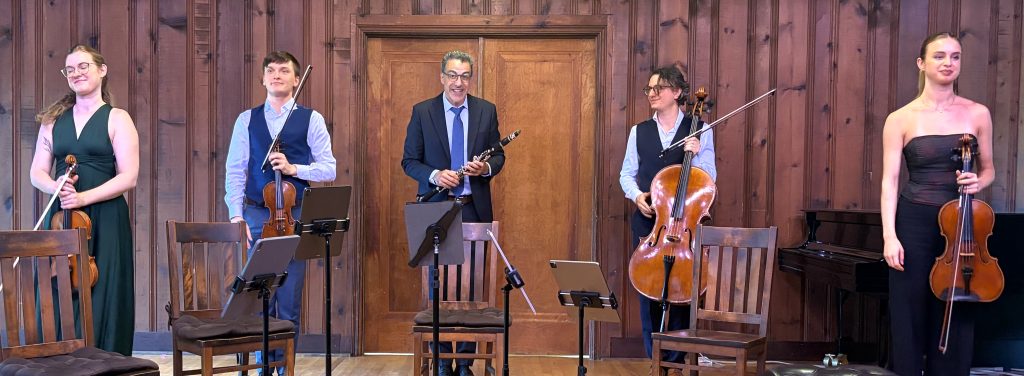
Erinys (meaning Furies) Quartet derives its name from the Oresteia by Aeschylus. They were founded in 2018 at the Sibelius Academy in Helsinki, Finland. They have toured Europe and the United States. Now they are the graduate string quartet in residence at Indiana University Jacobs School of Music. They have won many international awards.
The Quartet opened with the world premiere of a Clarinet Quintet named Romancero (2026) by Alfonso Fuentes (b. 1954), a Puerto Rican composer, pianist, and educator. Alfonso is a known composer on the international circuit, and he can be heard on hundreds of recordings.
Romancero was commissioned by Music Mountain in the spring of this year. Inspired by a simple folk ballad Fuentes heard at Music Mountain in 2018 as composer in residence at Music Mountain (2018), he created a dissonant opening, which sounded warlike, yet the quintet eventually resolves in the happy ambiance of soothing domestic tranquility. The rhythmic pace proceeds in measures of four and five with Caribbean rhythms that introduced many variations.
The soaring first violin of Elizabeth Stuart appeared to be at war with the thundering cello of Stergios Theodoridis, as the second violin of Joosep Reimaa supported the first violin, as the viola of Marija Raisanen delivered effective suggestions. The clarinet role with Oskar Espina Ruiz was spectacular. I have always enjoyed his clarinet, yet here he was in top resonant form. The clarinet is the closest instrument to the human voice, and it was the clarinet that dramatically persuaded the other warring instruments to arrive at a resonant musical solution.
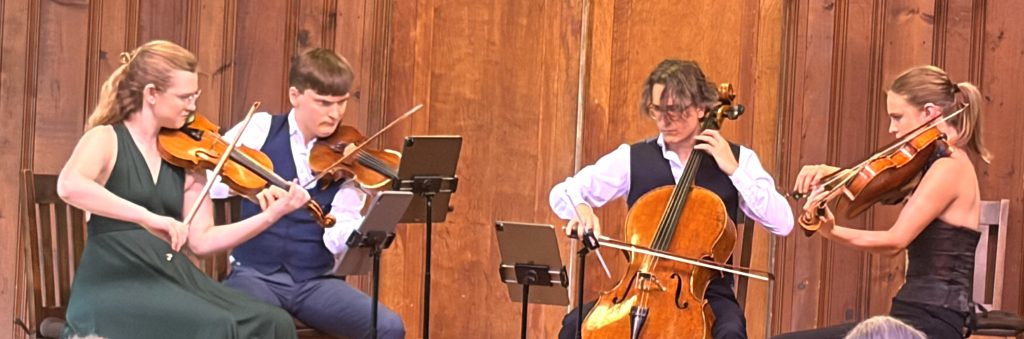
String Quartet in D Minor, D. 810 by Franz Schubert features the nickname “Death and the Maiden,” a meditation on the much-depicted painterly Medieval theme of early death, a fate that Schubert himself was a victim of (likely from typhoid fever), dying at 31 after producing a prodigious output of unmatched German songs and impressive musical masterpieces. Composed during a bout of illness in 1824, the work retains an iconic impact on the brevity of life. This opus also announced the full maturity of Schubert’s inventive style.
The performance was robust, melodic, piercing, and memorable with all four string players tightly welded in melded unison with the theme of accepting the inevitable conclusion of life for everyone, and even of humanity itself. The rhythmic thundering hooves on the temporality of life remains most memorable. The audience erupted for a standing ovation, demanding two long bows.
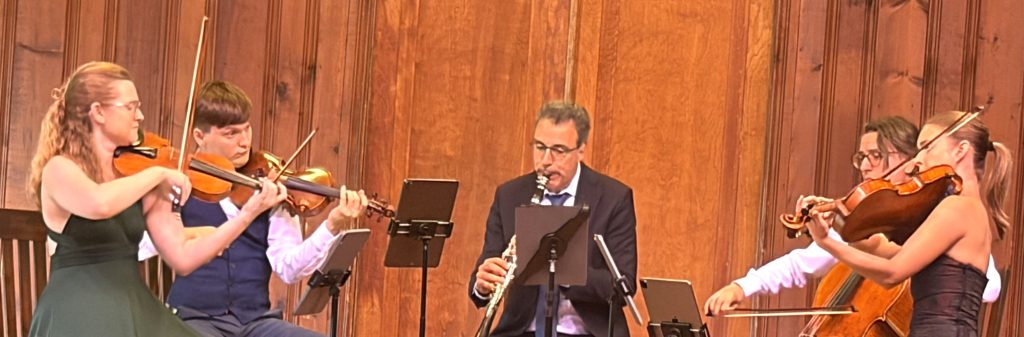
After the intermission, they performed Clarinet Quintet in A Major, K. 581 (1789) by Wolfgang Amadeus Mozart, composed ten weeks after the storming of the Bastille in Paris, during the repressive police-state emergency that Austrian Emperor Joseph II imposed as a reaction to what had happened in France. (Constanze later destroyed all of Mozart’s letters from this period.) Although Wolfgang was busy composing a new opera, Così fan tutte, he somehow found the time to compose this quintet for his good friend Anton Stadler, who played basset clarinet in A, his instrument being slightly larger than the common size. The result was an exquisitely warm celebration of friendship and the instrument. This tautly woven work remains one of the most famous clarinet compositions.
The gentle opening bars function as a recurring lyric motif, the clarinet dancing through the range of the instrument with Oskar Espina Ruiz (the genial Music Director of the Music Mountain series) swaying through a marvelous web of liquid notes trailing into the room while the strings overlay, bedecking the instrument as if it were a floating reverie available for each listener to fill in their cherished recollection.
The concluding Larghetto offers a simple ABA line resembling an operatic love song where the clarinet becomes the lead voice in a dialogue duet with the first violin which results in an ironic staccato no-reply as the clarinet politely rejects the first violin with light-hearted ambiance; the second violin and magnificent viola being also dismissed as the cello affirms the fate of the strings as not being as worthy, the clarinet being the popular voice of humanity at large.
Next Sunday at 3 pm, the Harlem Quartet will offer a lively program:
Ludwig van BEETHOVEN String Quartet in A Major, Opus 18/5
William GRANT STILL Lyric Quartet
Aldo LOPEZ-GAVILAN Frère Jacques
Caroline SHAW Entr’acte
Fanny MENDELSSOHN String Quartet in E flat Major