by Kevin T McEneaney
Franz Joseph Haydn essentially created the quartet in the 1760s and nurtured it to maturity with Mozart. The commission for Beethoven to compose his first quartets arrived in the autumn of 1798 from Prince Lobkowitz, who requested six quartets; at the same time, the prince also requested six quartets from Haydn, who was overbooked and he only produced two quartets for Lobkowitz, Op, 77 and the belatedly unfinished Op. 103.
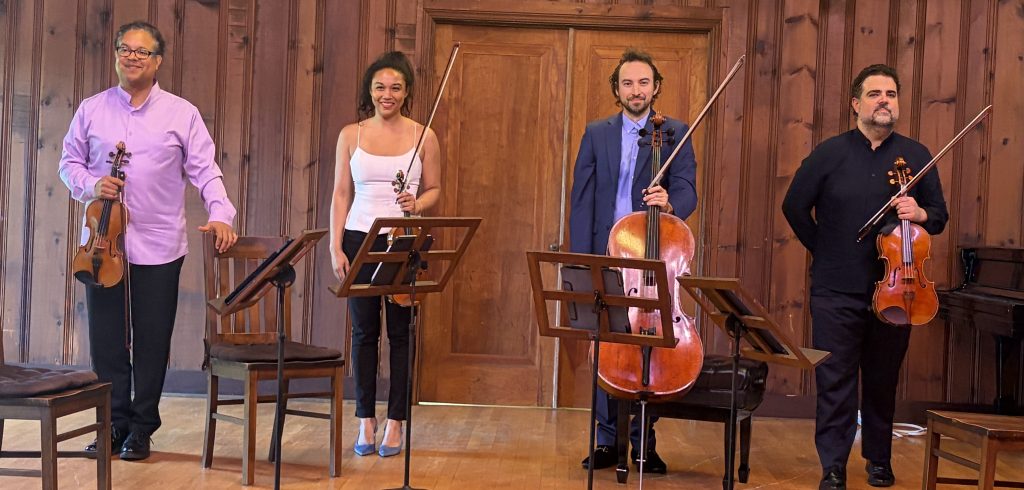
Beethoven was the resident pianist at the prince’s court, and he was happy to have the commission. Beethoven promptly began the project, yet he had to teach himself how to write a quartet. Only the fifth and sixth of the series remain in concert repertoire. The Harlem Quartet opened with Beethoven’s String Quartet in A Major, Op 18#5 (1799), which was the twenty-first performance of this work at Music Mountain. In the actual order of composition, this work is the fourth of the six compositions.
This is the friendliest and most popular of the six quartets; it is greatly influenced by Mozart’s string quartet KV 464 in its formal structure and partially matching movement headings. What remains striking is the eloquent dominance of the first violin here played with astonishing finesse by Ilmar Gavilán. At this point, Beethoven was influenced by Napoleon and the ambiance of power. This quartet offers a showcase for ambitious violinists.
The other three instruments contest the violin and offer a subsidiary theme that challenges the violin in the third movement; then they arrive at agreement for the vigorous finale. One might say that the work is an allegory of how government should operate: vigorous debate leads to reasonable compromise. The audience appeared to understand the allegory as a representation of our current political situation and demanded two bows for this superb performance.
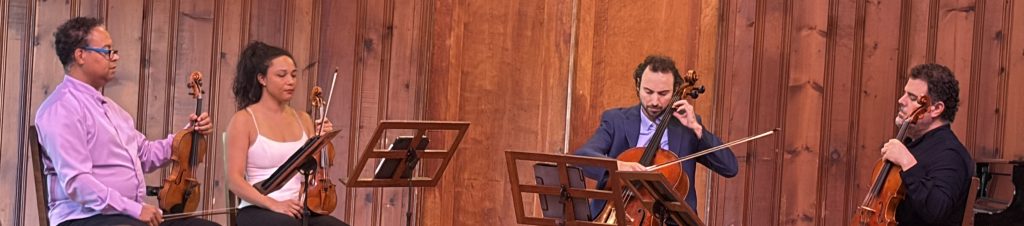
Lyric Quartette (1960) by William Grant Still offers a musical portrait of three friends: The Quiet One, The Sentimental One, The Jovial One. They performed the first two movements. The first movement was warm, redolent with tranquil emotion, as the ensemble played as a single cooperating unit with an attractive rippling rhythm. The second movement opened with rhythmic fluctuations, as if traveling through a collection of memories with nostalgia. There is gentle pizzicato that provides an endearing frisson. I really loved these short pieces. Still is an American giant whose works are not as often performed as they should be.
Guaguanco (2016) by Guido López-Gavilán (b.1944), father of the violinist, was a Cuban clavé (drumming rhythm split into two measures over an eight-count), a dance pattern which was elevated into the sphere of classical composition with satisfying tension as the rhythm appeared as a group as well as solo improvisations. While rather short, it was ebullient and electrically satisfying, bringing an odd breeze of fresh air
After Intermission, the quartet opened with Entr’acte by Caroline Shaw (b 1982). This 2011 plucking piece was about time. By turns it registered boredom, excitement, memory, crying, and amusement. It was concise and witty, assigning short solos to the four instruments.
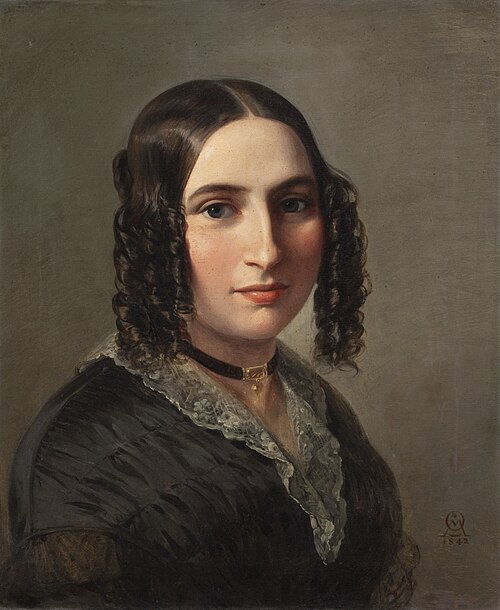
String Quartet in E-flat Major (1834) by Fanny Mendelssohn Hensel (1805-1847) was the closer. At thirteen she performed from memory all twenty-four of J.S. Bach’s Well-Tempered Clavier for her father’s birthday. In 1820 when she was confirmed, she chose the name Cacelia, the patron saint of music. Her father disapproved of her composing music, but she managed to compose about 466 works during her short life. This string quartet was the only quartet she ever wrote. (Munich has a Fanny Mendelssohn Quartet.)
The opening melodic Adagio announces enthusiasm and exuberance as the second violin of Ade Williams asserts leading independence, yet in the following Allegretto she is rebuked by the fatherly, grumpy cello of Felix Umansky, who is adamantly self-assured. The third movement, Romanze, allows the first violin of Galiván to shine with passion, and the concluding Allegro celebrates the felicity of completing the quartet as the viola of Jamie Amador absorbs all tensions into a shining finale.
This was a thoughtful, lively, and marvelously performed concert under sunny skies….
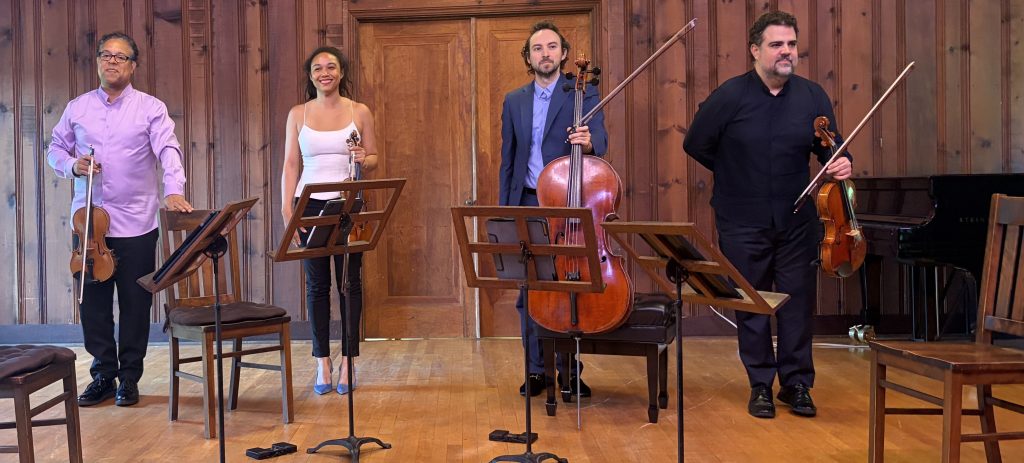
Next Sunday at 3 pm at Music Mountain: Ulysses Quartet with Max Levinson on Piano:
Works by Seth Grosshandler, Wolfgang Amadeus Mozart, and Robert Schumann