by Kevin T McEneaney
Homer’s Odyssey offers a series of blatantly unbelievable episodes from start to finish. The Greek language is haunting, witty, memorable, and eloquent. Homer is the uncontested master of vowel sounds, with Dante Alighieri, Ludovico Ariosto, and Alexander Pushkin swimming in Homer’s wake. One could add Chaucer to that list.
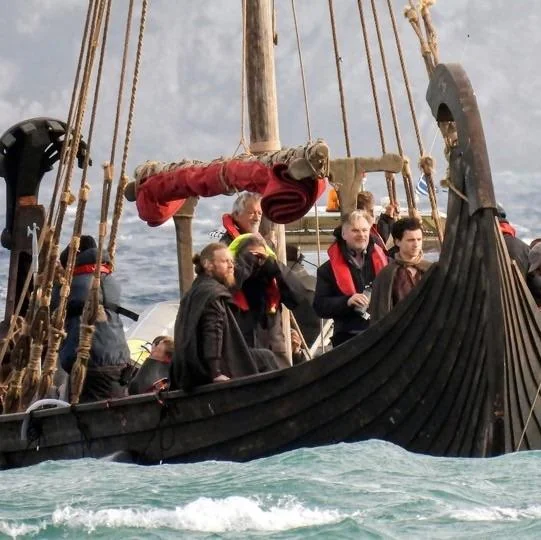
In his The Odyssey, Nolan takes small liberties with the text, and those liberties work in a populist mode. Nolan has cut the last four books of the epic because both scholars and the average reader know that the last four books are add-ons from a later poet. The Phaeacian episode with Nausicaa is omitted, which would have added another twenty minutes to the nearly three-hour film, yet that episode remains the most delightful part of the epic since it celebrates hospitality. Nolan depicts storms like the painter J. M. W. Turner.
About sixteen years ago, I spent two years doing my own translation of the Odyssey (never published). Online essays and commentaries now swamp the Internet. There is much nit-picking about individual actors, yet that remains chatty nonsense, since the acting is good despite its excess testosterone.
Matt Damon as Odysseus is far too broodingly introspective and lacks the sunny wit of the original, while Tom Holland as Telemachus sensibly mingles insecurity with insecure ambition. Anne Hathaway enacts a strong Penelope. Names in Homer carry odd innuendo. Penelope means one who eloped with a penis, here the King’s son. Telemachus means fighter from afar, that is, a bowman, which he is not; Odysseus has named his son for his father’s virtue and his son lives in his father’s shadow.
Although there is much brooding darkness, the photography in the film is quite stunning!
The seven-year love feast with Calypso provides charm for the warrior whose brain is ultra-damaged by the horrors of war and moral deceit, while it supplies idyllic charm. There is poor stage equipment when Odysseus looks at the remnants of his ship: some brown painted machine-cut floorboard scraps that you might have in your basement. (I suppose that this is just a modern joke.) The episode of the Cyclops is quite impressive and arresting, and the scene with the witch Circe (unfortunately pronounced with the Welsh Slavic hiss) turning the warriors into greedy pigs delivers fantastic amusement.
The episode where Odysseus loses eleven of his twelve ships is thrilling, but rather mechanical. The Laestrygonians are depicted as giants wearing Medieval metal outfits. In Homer’s text, they are said to practice the worst form of government, pure democracy by shouting with voice vote, and they speak a language with grunts and gestures that human beings could never learn, although they resemble human beings. I think Homer presents some time-traveling fiction about our Neanderthal relatives, who destroy the eleven ships by hurling giant boulders (too expensive to film that scene).
The conclusion after the vivid slaughter in the hall does not offer the famous joke about the bed carved from a large stump, followed by lovey-dovey patter between husband and wife with arms around each other, yet it suggests a hopeful, more resonant future. Ithaca is abandoned as a heritage laden with blood, blasphemy, and horror.
They set sail for a new beginning to colonize an uninhabited island where they may be able to live lives with sanity, morality, and especially peace. The point of all the violence in the epic, as well as the film, is that civilization is built by love and laws, in this case by xenia (hospitality and friendship), which is the central theme of Book 7 in the Odyssey and omitted in this version.
This film appears at a time when generosity and hospitality appear to be in decline. The epic argues that war is never a satisfactory solution. This is not a definitive Odyssey, yet the photography is constantly stunning. The film is worth seeing.