by Kevin T McEneaney
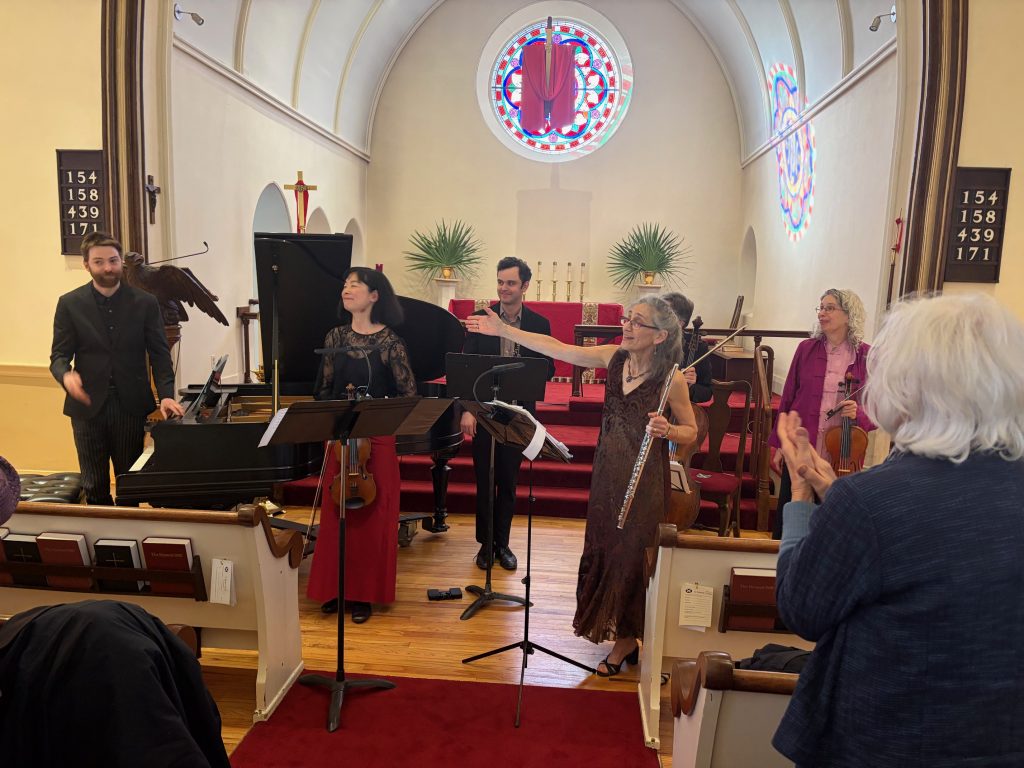
Last Sunday at St. Andrews Church in Kent, with warm sunshine and a cool breeze in the air, The Sherman Ensemble presented its annual Best of Baroque concert. They opened with George Friedrich Handel’s Trio Sonata in Bb major, Op. 2, No. 3 arranged for flute by S. Fryer. This early, pleasant, Baroque composition served as a foil for the more complex compositions that followed. Handel was born on February 23, 1685, on the same day that Domenico Scarlatti and J.S. Bach were born. (We don’t know at what hours.)
Bach specialist Evan Shinners on piano trilled the principal motif while Jane Chung on violin brightened the tune while Susan Rotholz on flute delivered dramatic highlights during the four movements. Rotholz was fabulous on the two Allegro movements!
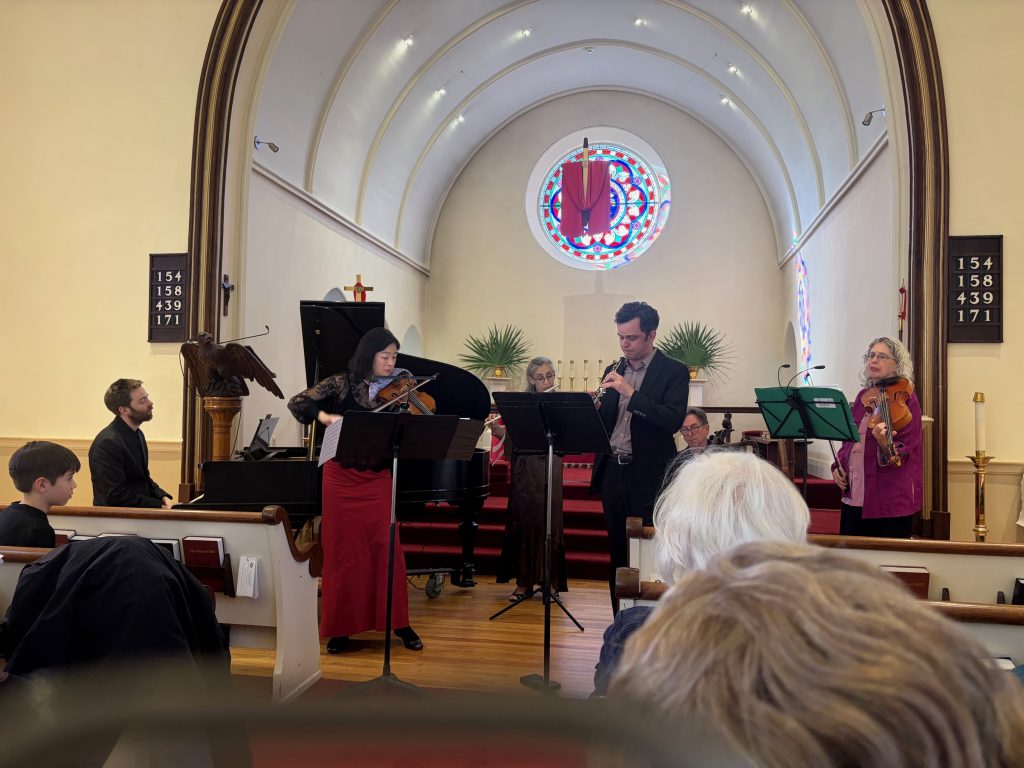
They next performed Concerto for Violin and Oboe in C Minor by J.S. Bach, BWV 1060R. Shinners on piano laid down the theme in the Allegro while Noah Kay on oboe took the lead, playing melodic variations with silvery ease. In the more somber Adagio, Jane Chung on violin provided a moving lament. The concluding Allegro offered a reversal: enthusiasm blossomed into exaltation and contagious excitement, with all instruments delivering a galvanized aesthetic that blended into a forceful unity. Here, Eliot Bailin’s cello and the viola of Susan Adams contributed to the marvelous resonance. This composition is usually performed by an orchestra at least thrice the size of these players, yet their unity of sound blended as if they were a much larger group of musicians.
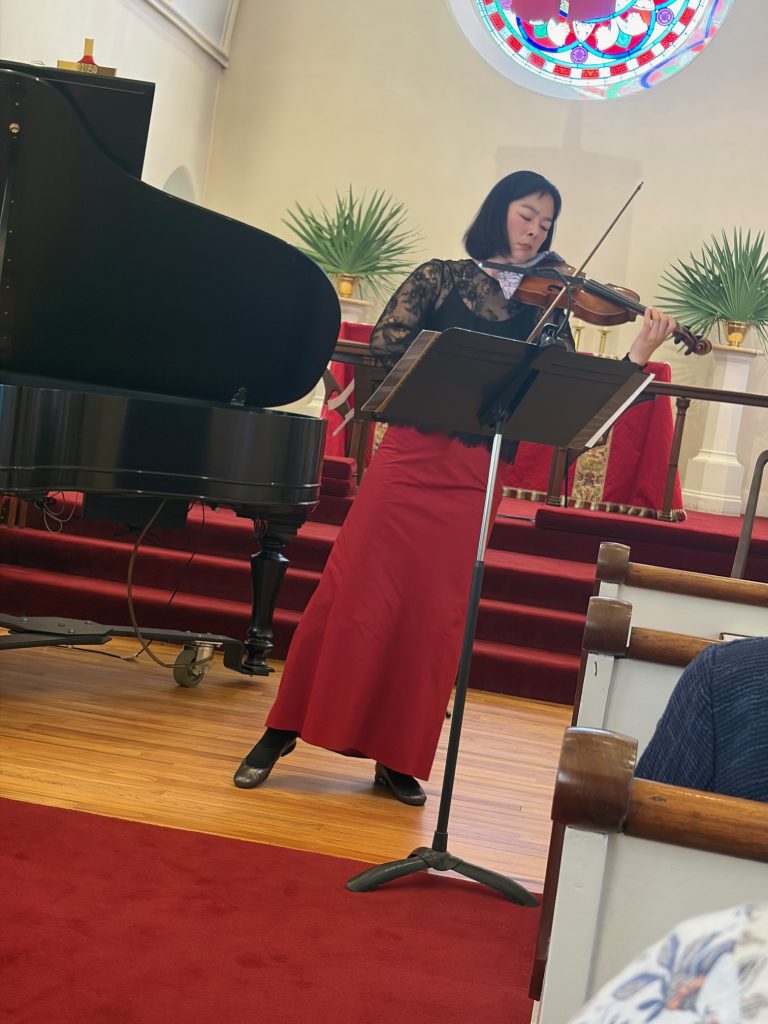
Jane Chung played Passacaglia for Violin Solo by Heinrich Biber (1644-1704), which was only discovered in 1903 as part of the Rosary Sonatas. The unaccompanied violin works with a descending tetrachord in an improvisatory manner, twisting up and down, below and around the chord, as if to dramatize the incredible mystery of creation. This unusual solo is meant to be played by a star violinist and then be followed by an amateur flute player to dramatize the folly of us stumbling humans in the wake of creation. Chung played with vigor in this acrobatic line with a borrowed violin on loan, a Naples violin from the early seventeenth century, about the time that the composition was written. This was an amazing treat!
Keyboard Concerto in E Major, BWV 1053 by J.S. Bach stems from his years in Cöthen, about 1720, when Bach was Kapellmeister to Prince Leopold, when Bach wrote his famous Brandenburg concertos. While no tempo had been indicated, Evan Shinners supplied a lively tempo for the other five players. The lilting Siciliano second movement permitted the flute of Susan Rotholz to shine and the oboe of Noah Kay to resound with resonance. The emphatic aba motif flourished in the concluding Allegro.
The concert concluded with Concerto for Flute and Violin, TWV 52: e2 in E Minor by G.F. Telemann (1681-1767). I had never heard this superb work in four movements, which filled my heart with wonder. The six-player ensemble surpassed themselves. The opening Largo was intriguing, the Allegro impressive, the Allegro brimmed with energy, while the second Largo featured a lively interplay between flute and oboe, and the final Presto offered transcendent energy. Evan Shinners ran up to the organ loft to play the organ for the two slower Largos. All six musicians achieved group fusion in the final movement!
This was a concert to remember, to hold in one’s mind for at least a month….