by Kevin T McEneaney
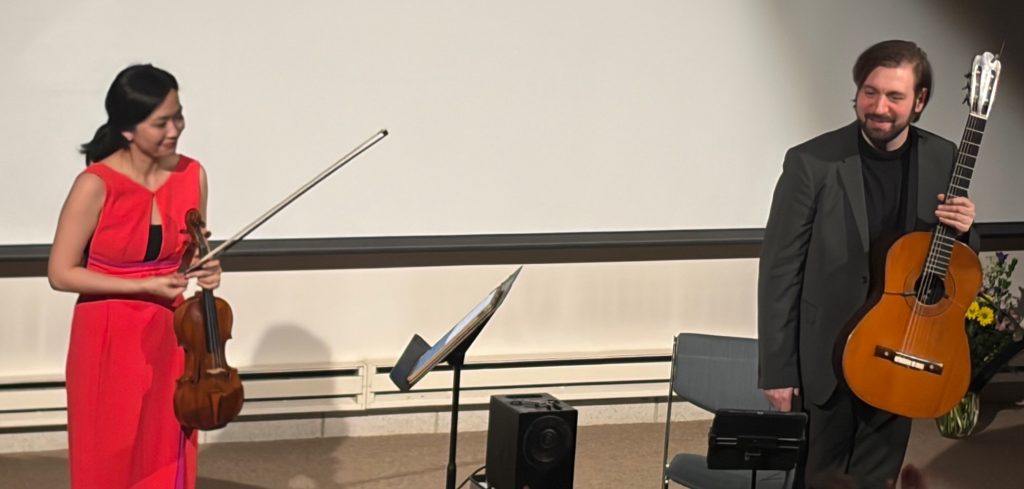
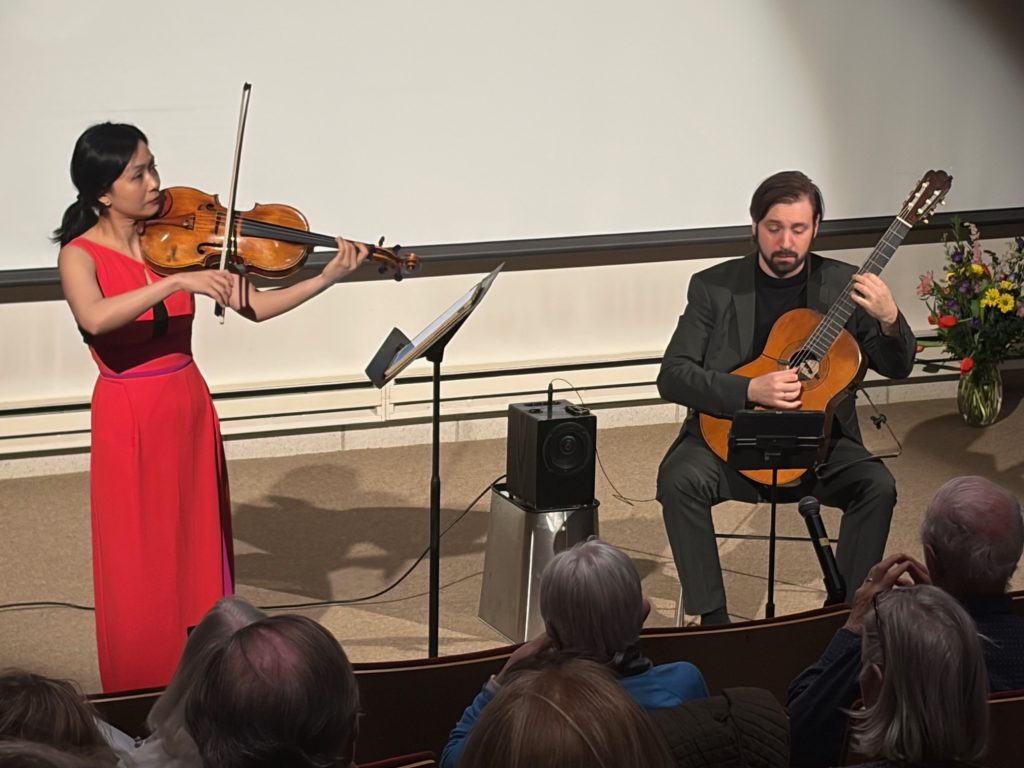
Introduced by Artistic Director Sophie Zhou from the Millbrook Music Salon, this past Saturday afternoon at the Cary Institute Thomas Lovejoy Auditorium, violinist/violist Luosha Fang and Swedish classical guitarist Jacob Kellerman delivered an exciting and unusual duo program. Luosha has won many international awards; she can be heard on two recent recordings, with a third disk being released in a few months; she teaches at Bard College. Classical guitarist Jacob, who hails from Sweden, has published four disc recordings while appearing as a soloist in many European countries.
They opened with Sonata for Arpeggione and Piano in A minor, D.821 (1825), which was in three movements. The arpeggio was a bowed guitar, an early novelty before the modern guitar. Today, this work is usually performed with piano and cello, and sometimes with a small orchestra. The lengthy opening Allegro moderato sounds quite Romantic yet appears to conclude with a series of sober questions. The Adagio lolls in a deep searching motif that remains poignantly mysterious. The lively Allegretto provides a happy conclusion free of confusion. The performance was energetic and immaculate!
They opened with Sonata for Arpeggione and Piano in A minor, D.821 (1825), which was in three movements. The arpeggio was a bowed guitar, an early novelty before the modern guitar. Today, this work is usually performed with piano and cello, and sometimes with a small orchestra. The lengthy opening Allegro moderato sounds quite Romantic yet appears to conclude with a series of sober questions. The Adagio lolls in a deep searching motif that remains poignantly mysterious. The lively Allegretto provides a happy conclusion free of confusion. The performance was energetic and immaculate!
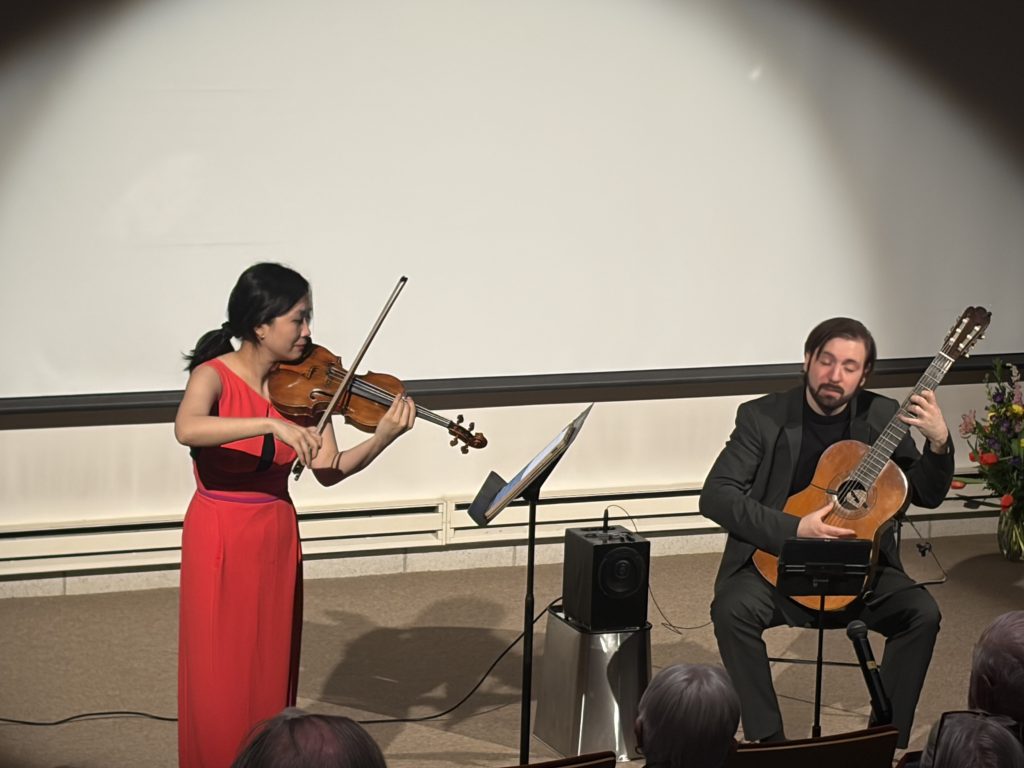
Seis Canciones Populares Espanolas by Manuel de Falla (1922, written in Paris) remains the most popular work of the first modern composer in Spain. First arranged for piano and soprano, this work enjoys a multitude of arrangements. (Falla made a violin arrangement.) The first of the six songs comes from various provinces of Spain, El pano moruno (the Moorish cloth), celebrates a young virgin shopping for her wedding dress and the store owner gives her an unexpected discount. Seguidilla murciana is a flamenco gypsy dance that celebrates two ardent lovers dancing in public. Asturiana (from northern Spain) tells the story of a woman lamenting her husband’s death. Joto, my favorite of the series in 3/8 time, offers the exuberant dance of two people passionately in love. Canción is a lyrical love song at night. Polo is a passionate song of revenge by a jilted lover. These gong motifs were great fun!
After a very brief break, they returned to play two Sephardic love songs composed by Francisco Coll, a friend of Jacob. These were short yet quite moving, a superlative treat.
Lachrymae, Op.48 (1950) by Benjamin Britten was next. This composition was inspired by John Dowland, who is thought to have written much of the music for Shakespeare’s plays, here written for piano and viola. This was a lament for the damage accrued by World War II. The viola being played by Luosha was from 1685 (on loan from Bard College) while Jacob’s guitar was from 1888 with contemporary strings. This dramatic lament offered contrast to the preceding love themes..
The concert Finale was Three Miniatures by Fritz Kreisler that offered a reversal of mood and the sincere hope of optimism for love and peace in the now!