by Kevin T McEneaney
In co-operation with the Kovner Foundation, The Millbrook Music Salon, under Artistic Music Director Sophia Zhou, and The Thorne Center produced an eclectic concert of notable fragments, addressing a wide variety of styles.
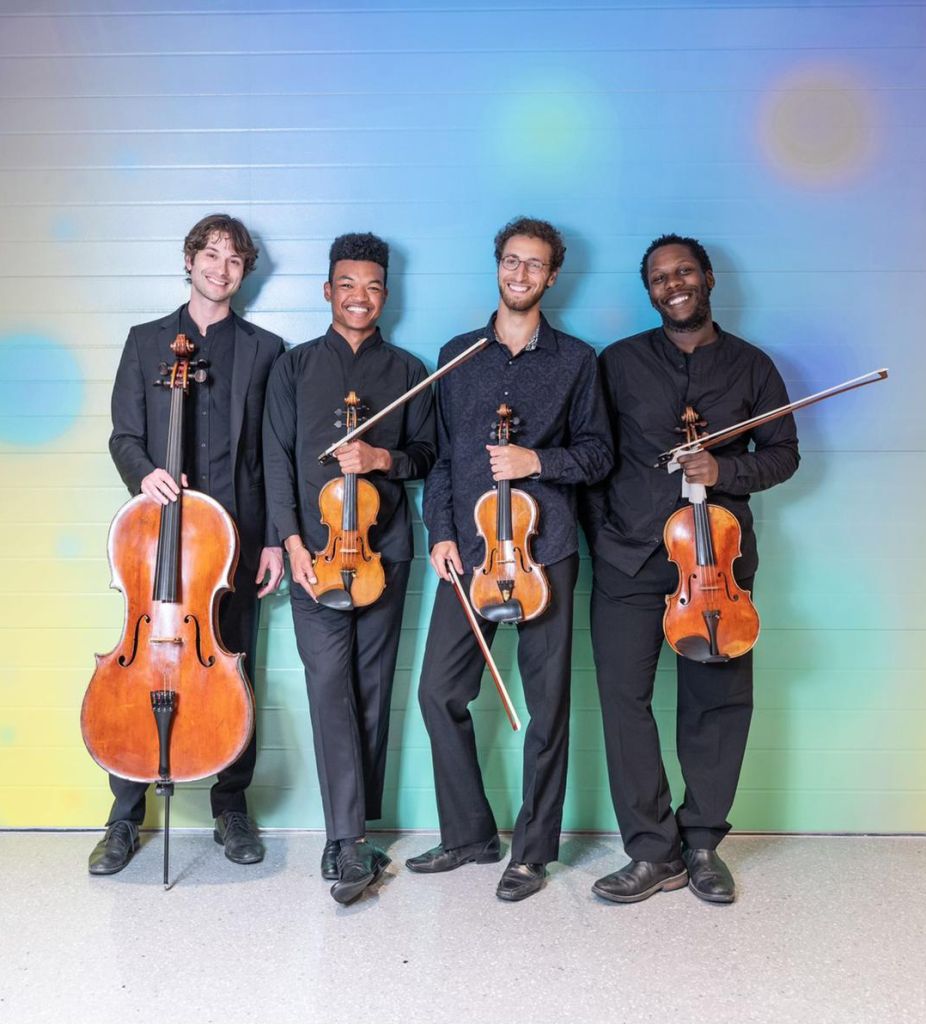
The Renaissance String Quartet opened with the second movement, Andante, from String Quartet No. 1 in G Major (1929) by Florence Price (1887-1958), which blended late-Romantic harmonic elements with African American folk rhythms in a poignant depiction of a rural landscape. First violinist Randall Goosby led with plangent melody that evoked childhood nostalgia for grasslands and forests recollected through the flittering vails of ardent memory and sumptuous counterpoint. The third movement (Juba) from String Quartet No. 2 in A Minor followed as it combined juba dance rhythms with classical elegy to depict an Otherworld devoid of hardship and struggle, where the cello of Daniel Hass excelled.
The Andante Cantabile and the concluding Molto Allegro from String Quartet No. 1 in G Major (1782) by Wolfgang Amadeus Mozart (1756-1791) was the second of six quartets written by Mozart when he undertook study from Haydn, who happily realized that he had finally found a worthy successor. Cantabile is a slow songlike melody where the dexterous viola of Jameel Martin stood out; the audience was asked implicitly to compare the melody in G to that of Price’s music. While young Mozart was very good with his four successive themes, it was clear that Price had excelled with melodies that were more memorable than Mozart’s. In the concluding Molto Allegro, Mozart offers a prank: a false ending of loud, jarring chords to tease his teacher, then a smooth, quiet cadence of the four themes that resolves with unexpected panache, thus illustrating a different kind of temperament from Handel or Price.
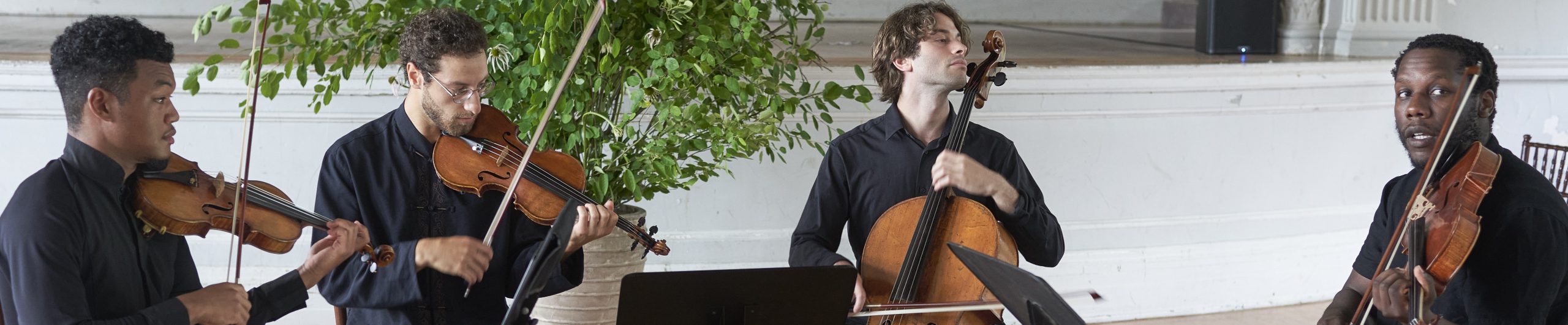
String Quartet No. 2 in A Minor, O.51 (1873) by Johannes Brahms (1833-1897) was one of the three quartets that were published during his life. Brahms had composed 26 string quartets but destroyed the other 23 before his death. If he didn’t think that a quartet exceeded Beethoven, then it would be worthless. The opening Allegro, well done with depth by second violinist Jeremiah Blacklow, offers radical contrast without eliminating the integrity of the work, evoking contrasts by employing the same themes in a different style.
Same themes in a different manner was a process encoded in Daniel Hass arrangement of Bob Marley’s “Satisfy My Soul” where the soul resided in the voice of the cello rather than inhabiting the advice of the other three instruments. Similarly, Hass’s arrangement of Bob Marley’s “I Shot the Sheriff” employed themes from the pop song, yet the result sounded like there was no relationship between Hass’s sense of music and Marley’s, and that peace should prevail over shootings.
The closer was String Quartet No. 1, Sz. 40 (1908) by Béla Bartók (1881-1954). They performed the opening Allegro Vivace, which dramatizes an unrequited love for a female violinist. This Vivace resembles a funeral dirge. I was momentarily shocked, yet on my way home, I thought this peculiar choice might be a contemporary political allegory. Randall Goosby on violin was superb!
This concert had a quirky selection of snippets that made one think about how unlikely surfaces may resemble each other. It resembled a jig-saw puzzle that one’s ear must solve….
PHOTOS number 2 & 3 are courtesy of The Millbrook Music Salon.