by Kevin T McEneaney
Monody was invented at the Medici court in Florence around 1580 by Vincenzo Galilei, father of the astronomer Galileo, who set a passage from his son’s Inferno (the Ugolino episode), as well as a passage from the laments of Jeremiah. This established the basso continuo lines for two instruments whose roots resided in the organ line, the organ doubling whatever was happening in the lower part of the polyphonic line.
The renowned singer of the era was Giulio Caccini, who worked with Monteverdi to establish opera. Caccini was inspired by a passage in Plato, which emphasized the importance of vowels in music that then became the signature stylistic approach of Italian opera (which works better in Italian and French, while English, in its origin, was primarily a consonantal language).
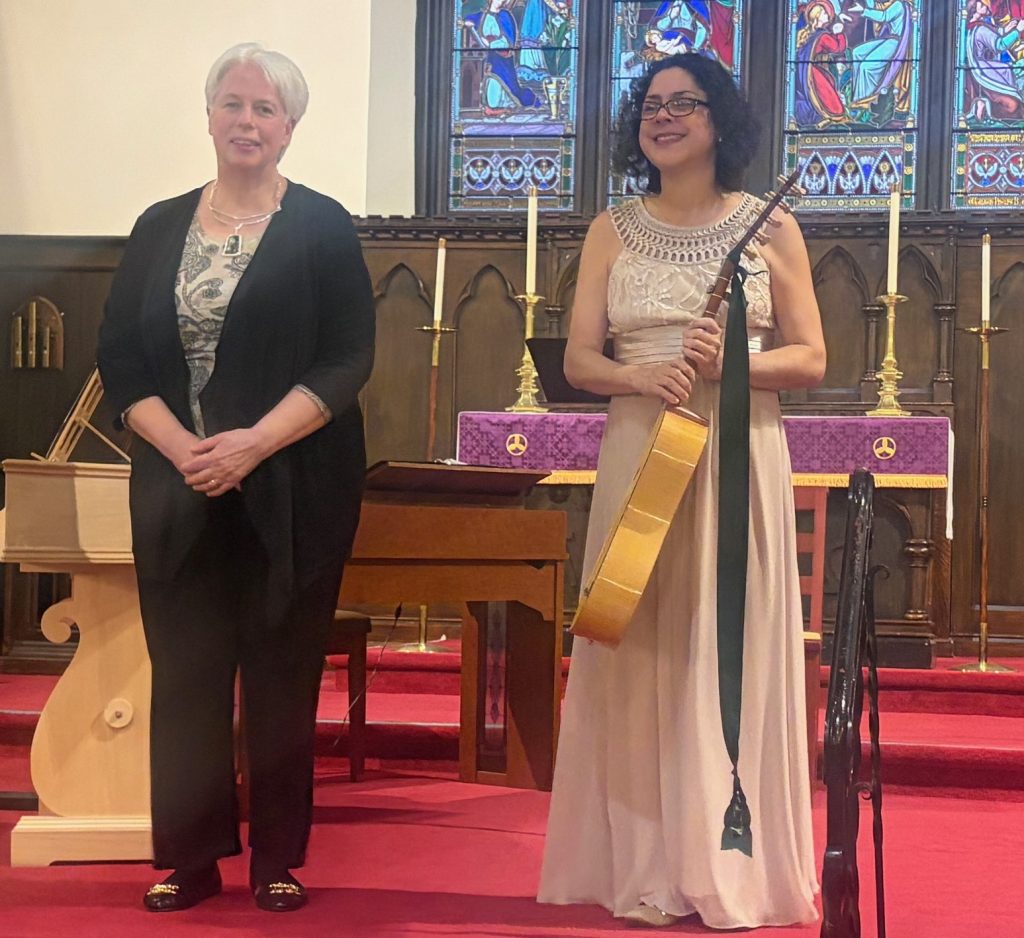
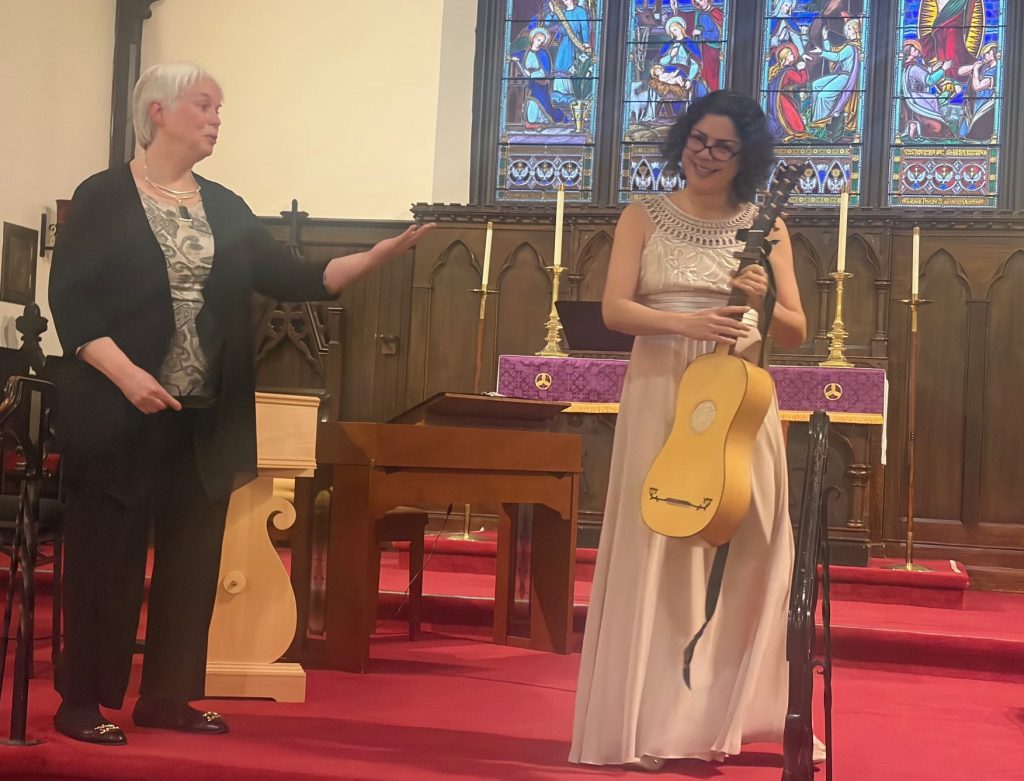
Giulio’s daughter Francesca was the first female singer to have a book of compositions published in 1618. Her nickname was “the songbird.” This concert celebrated the songs of Francesca Caccini and her contemporaries. Christine Gevert played the virginal organ, accompanied by a current Venezuelan songbird, Salomé Sandoval, on lute at Trinity Church in Lakeville last Saturday.
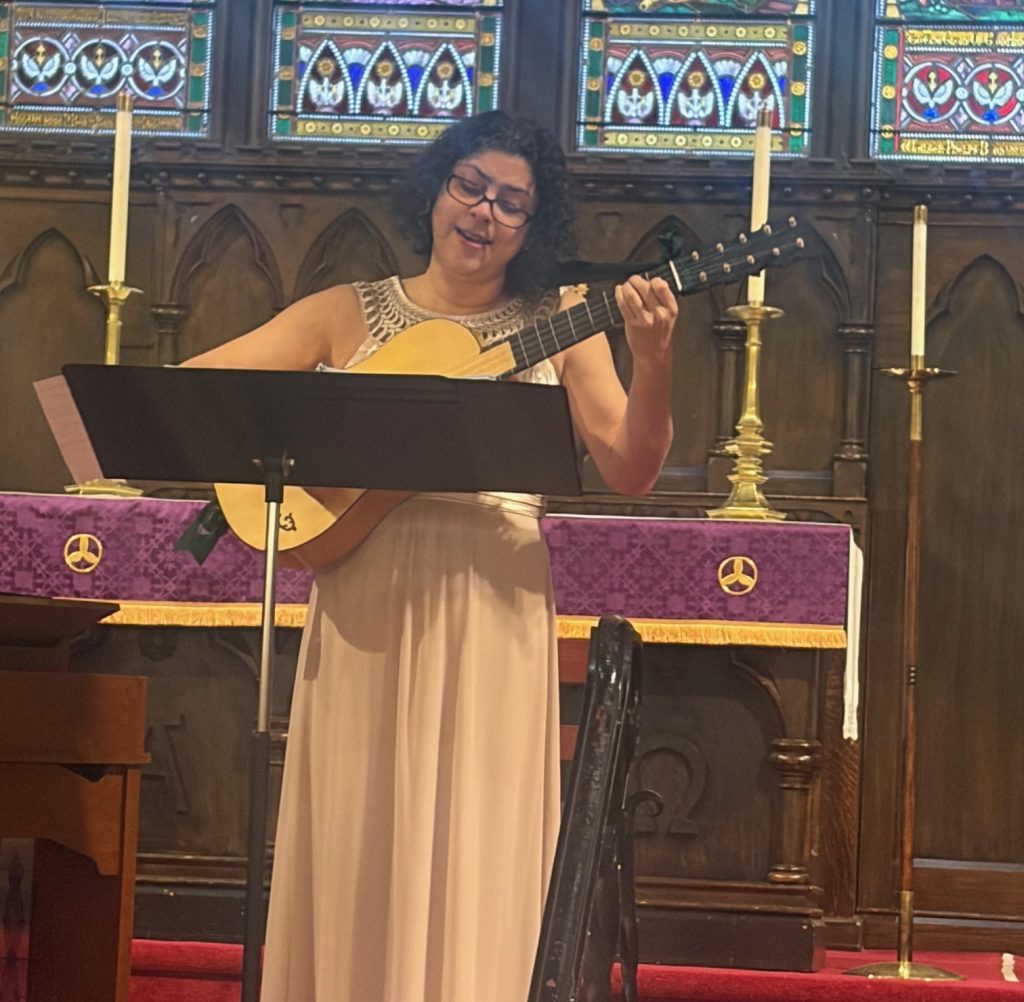
These Renaissance songs celebrated love, religion, and the loss of love with acrobatic elisions of vowels, a style of singing not cultivated by the English language yet retained in Spanish. Soloing on the virginal, Christine Gevert played two interludes: a recercar and toccata by Girolamo Frescobaldi (1583-1634).
Sandoval played lute and guitar, singing a series of songs with virginal accompaniment. She sang songs composed by Francesca Caccini, Lucretia Orsina Vizana, and Barbara Strozzi (1619-1677), a Venetian composer and singer who published eight volumes, more than any contemporary composer of her era.
As a Soprano singer, Sandoval sang with intimacy, drama, and astonishing verbal finesse, echoing the accomplishments of women with gifted, heavenly voices!
P.S. The origin of the alphabet appears lost in time. Early alphabets did not have vowels. The earliest known alphabet with vowels comes from the Mesopotamian Hurrian Empire (2000 BC-1335 BC). Vowels were notated only for religious music or the composition of religious fiction. The oldest surviving musical notations originate from the Hurrian culture.
Greeks adopted the standardization of vowels from the Hurrian legacy, c. 980, originating from Miletus. The father of the poet, nicknamed Homer (Outcast), was an Athenian who married a woman from Miletus (the original capital of the Greek empire), where he became a schoolteacher. A short list of the most famous poets with vowels: Homer, Dante Alighieri, William Shakespeare, Alexander Pushkin, and a flurry of French poets.