by Kevin T McEneaney
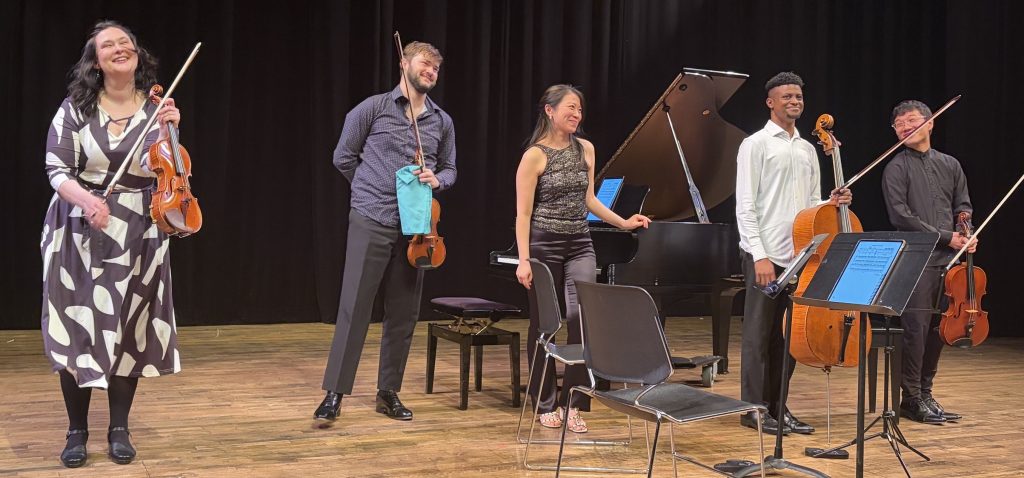
Last Saturday evening in Chelsea Morrison Theater at Millbrook School, Green Room Ensemble delivered a delightful program with a wink at the past and a plunge into the present. The ensemble, founded by violinist Nathan Meltzer offered a special emphasis on underrepresented contemporary composers.
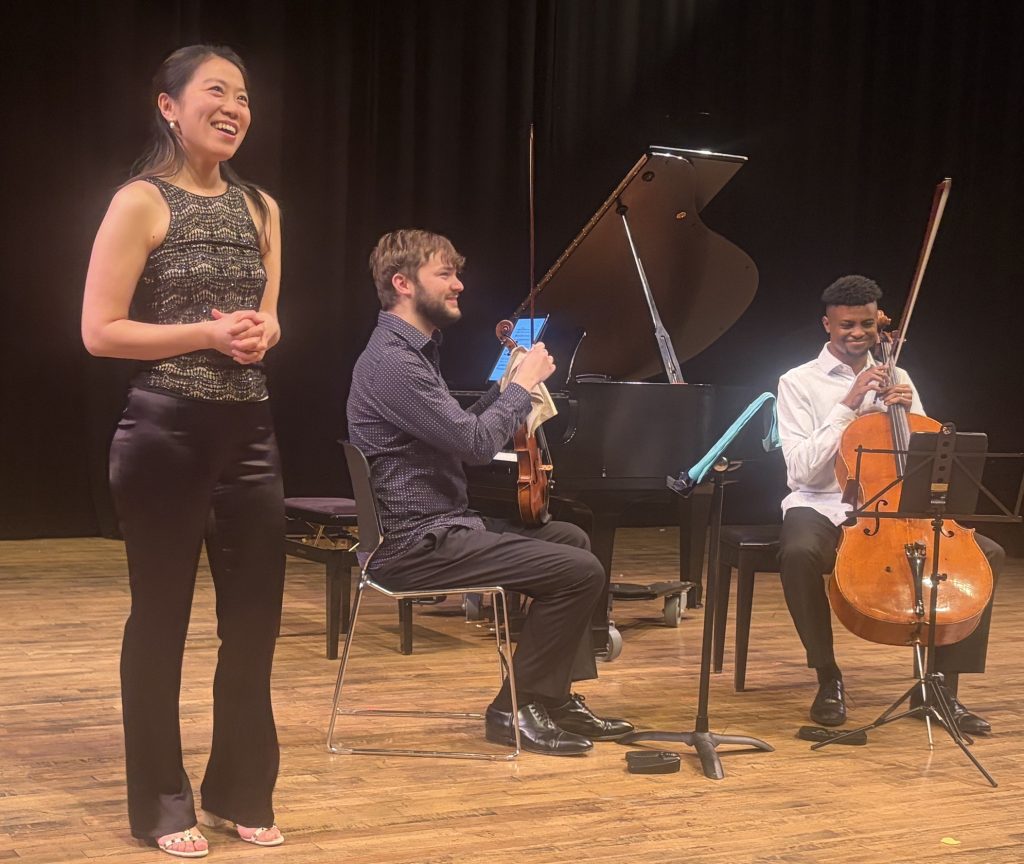
Meltzer, Sterling Eliott on cello, and Sophia Zhou on piano opened with Franz Joseph Haydn’s Piano Trio in E Major, Hob.XV:28 (1797, yet perhaps earlier). The opening ascending theme of violin and piano conjures sunrise, while the pizzicato in the cello resembles early morning bird chatter. The piano responds, affirming the same theme. Haydn, in a morning gown, is at the piano answering the birds with enhanced legato from the piano, which has established the composition’s main theme: the piano invokes yet goes beyond nature with witty ornamentation. The second movement passacaglia evokes an afternoon stroll through the gardens with cello ostinato recording Haydn’s footsteps. The winding ornamental line of the piano signifies exploring off the beaten track. The triple time finale indicates hurrying home for dinner before twilight, which is dramatized by diminishing and disappearing light. A delightful day of composing and strolling through a landscape idealized, disappearing with soft notes: joyful and satisfactory work that transcends landscape.
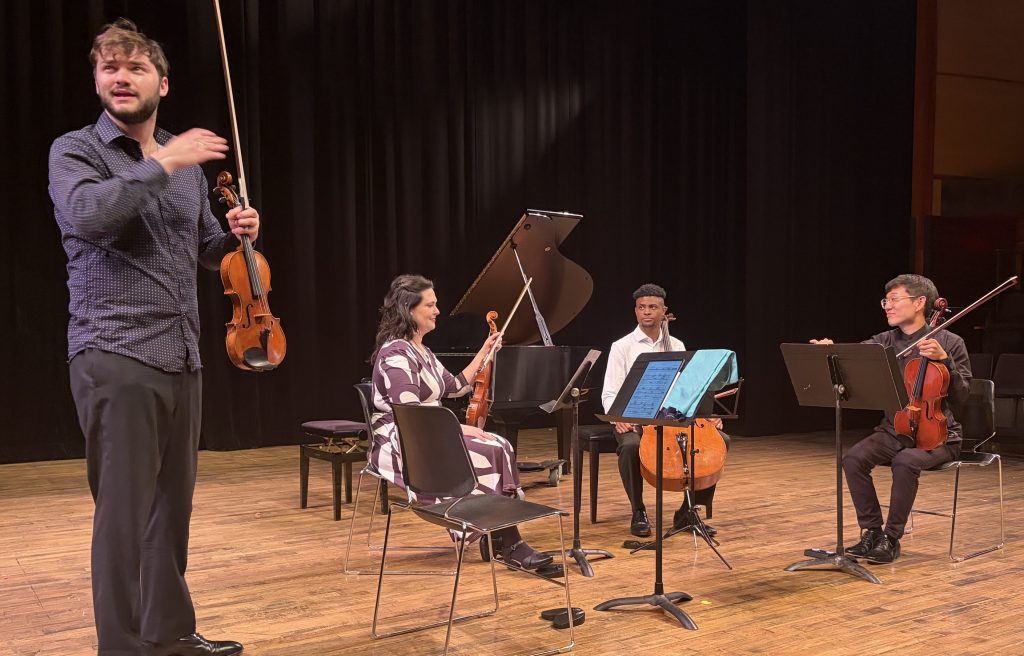
Misato Mochizuki’s Brains (2016–20/24) is an acclaimed contemporary cycle for string quartet with the theme of exploring neural mechanisms. The energetic opening dramatizes the working day with Meltzer and Ariel Horowitz on violin as if engaging in repartee. Eliott on cello appears to be recording subtexts, implications of activity. On viola, James Kang dramatically self-examined what is happening towards the end of the day, as if in a questioning conscience. There appears to be a descent into sleep, a turbulent dream, then a final, satisfactory resting resolution. Such postmodern pairing evokes parallelism between past and present with differing musical techniques. I thought the pairing with Haydn was brilliant.
Elliot and Kang performed Limestone and Felt (2012) by Caroline Shaw, a noted contemporary composer. This six-minute work dramatizes contrasts in textures and tones with much plucking on both instruments. Oddly, it appears to be a conversation, perhaps representing male and female sensibility. They played with impressive interactive finesse.
After Intermission the full quintet performed The Prospects of a Misplaced Year, Piano Quartet (2023) by Andy Akiho, a steel pan player and composer. This work is thirty-five minutes in duration with five movements, the first, “The War Below” by far the longest movement, which dramatized the difficulty of arriving at an abstract decision. The second movement, “Matchbook Aria” offered a slow, mysterious meditation that I found quite attractive. “(K)in(e)tic (V)ar(i)atio(n)s” offered pulsating rhythms while “Palindromic Queue” was satisfyingly mysterious. “On The tideS of november” presented a satisfying resolution.
Like the Haydn and Mochizuki piece, this was the working out of a personal situation that was more difficult and, albeit dramatic. Despite differences in time, aesthetics, and structures, this was a happy intertextual program of musical innovation with young musicians who are the top talent in the current music scene.