by Kevin T McEneaney
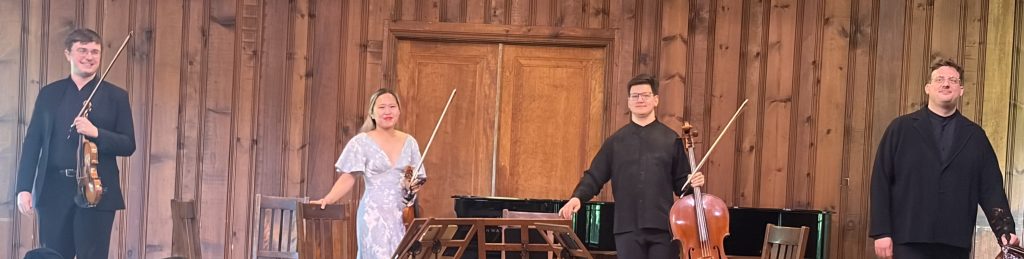
Under fluffy blue skies that provided an afternoon shower, the Baldouret Quartet opened with Maurice Ravel’s first composition, String Quartet in F Major (1903), dedicated to his teacher, Claude Debussy. At this point in time, Germans favored serial development, dismissing traditional cyclic development rooted in folk music as a limited vocabulary. French composers thought that a variety of techniques was a more sensible solution.
Frederick Delius and George Enescu (classmates who were controversial and unorthodox) also influenced this work. The first page of the work has nine meter changes in as many bars. At the time, many found the work far too Modernistic, although this first movement concludes with Romantic sensibility.
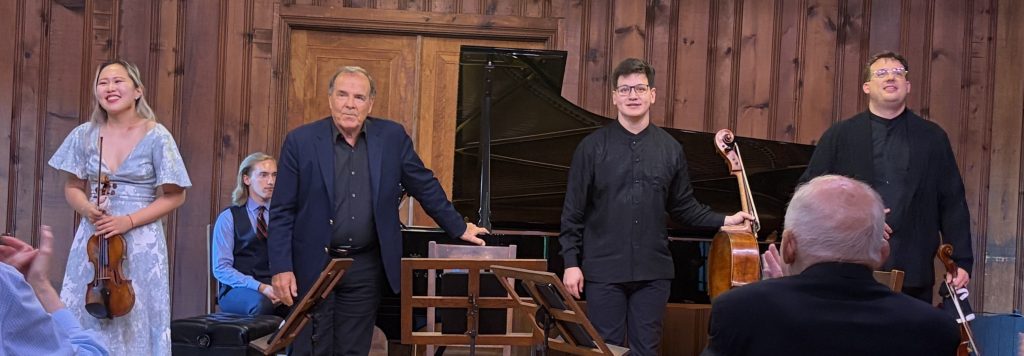
The first two movements had a cyclic form. The sweet, soft violins of Justin DeFilippis and Angela Bae opened and closed with svelte cyclic repetition in the opening Allegro. The rhythmic second movement opened with plucked strings. Bae’s second violin was no longer supporting the first violin as it engaged in conversation with the first violin. Justin’s Romantic opening plucked string motif was repeated.
The slow third movement shunned cyclic motifs, as if recalling redolent childhood memories. In the fourth movement, the viola of Benjamin Zannoni and the cello of Russell Houstin dominated with dramatic dynamics, announcing the signature of a new, original composer who delivered a thrilling finale.
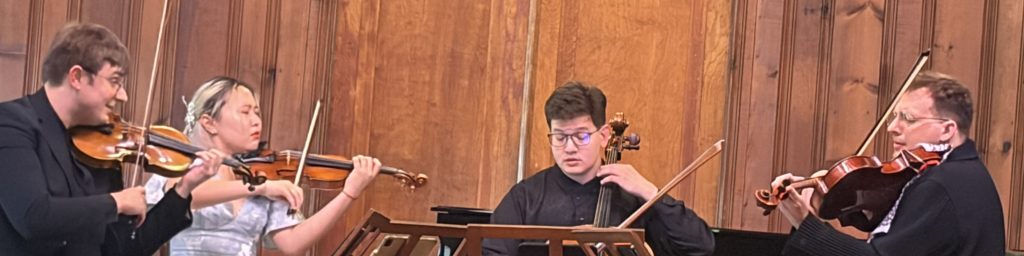
Galaxy Back to You (2024) by Nicky Sohn (b. 1992) offered an out-of-this-world experience. Sohn’s partner offered her the gift of a galaxy named after her as a cosmic birthday gift. There was a spiral galaxy discovered in 1791 that had a designated number but not a name. There are seven movements: Active Nucleus, Celestial Motion, Cosmic Dance, Mystical Steps, Water Masers, Supermassive Black Hole, and Gravitational Waves. The birth of the galaxy was a nuclear explosion that coalesced into processional agglutination. The Cosmic Dance celebrated group rhythm and the cello of Russell Houston excelled in Mystical Depths. Water Masers allowed the viola of Benjamin Zannoni to excel. Supermassive Black Hole once more featured Houston’s cello. Gravitational Waves was dominated by the violins with a slowing rhythm until there was only Justin’s violin plucking the last few “breathing” seconds of the galaxy’s demise. This was an exciting arc from birth to death with cosmic breadth, a marvelous current masterpiece of astronomical aplomb! This composition was written specifically for the Baldouret Quartet, whom Nicky admires. This work was an amazing sonic treat!
The third performance on the program was Piano Quartet in G Minor, Op. 25 by Johannes Brahms, written at the age of 24, and first performed by Clara Schumann in the autumn of 1861. Beethoven was clearly in the background as Brahms was influenced by Beethoven’s symphonic structures, but he clothed it with a richer, denser, and more fanciful fabric. The violinist Joseph Hellmsberger acclaimed the work, saying, “This is Beethoven’s heir!”
Was this the work of a young man in love? Clara Schumann must have been his muse, inspiring him to endow us with music whose gestures of majesty are tempered by a light-heartedness that pokes fun at pompousness. There are wild gestures, light figures, majestic themes, mock self-importance, and tongue-in-cheek pomposity as Misha Dichter on piano, ranging in octaves, as he led the talented group with Angela Bae on violin with ferocious speed in the final thunderous finale, which appears to disintegrate Romantic sensibility….
The capacity hall audience long applauded and demanded another bow.