by Kevin T McEneaney
String Quartets, Op. 59 # 1,2,3 (1806) by Ludwig van Beethoven are nicknamed “Razumovsky” after the Russian Count, who commissioned three quartets from Beethoven. Beethoven began working on the first of the three compositions on the day after his brother Carl’s marriage to a woman Beethoven despised (she was five months pregnant, nineteen years old, and from the middle class). Each of the three quartets was to employ a Russian melody. In the previous year, Beethoven had acquired a large three-volume anthology of Russian folk tunes and was eager to work with it; he was entering a rapturously productive period, leaving his brain on the cusp of insanity.
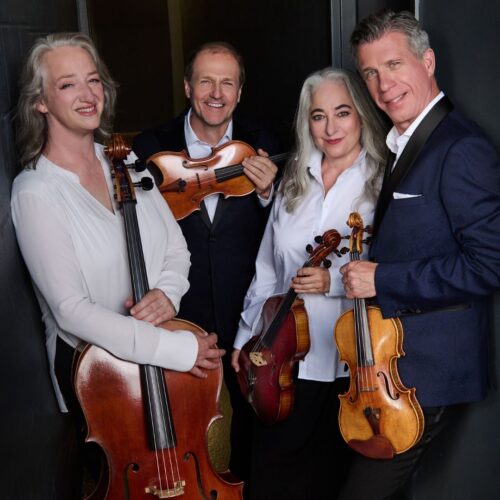
The first of the three sonata formats is quite extroverted, while the second is meditatively knotted and introverted. The Penderecki Quartet performed String Quartet, Op. 59 #2. The opening Allegro is deliberately fragmented.The lead violin, played robustly by Jerzey Kaplanek, wants some questions answered, but the viola and second violin express doubt whether the four instruments will be able to converse with each other on the proposed topic. The cello, marvelously played by Katie Schlaikjer, exudes confidence that the task at hand can be solved.
Carl Czerny once recalled that Beethoven once said to him that the E-major second movement fell into his mind when “contemplating the starry sky and thinking about the music of the spheres.” The amusing scherzo with a peculiar funky beat is also in E minor, as the second violin of Jeremy Bell and the viola of Christine Vlajk pose questions about a Russian melody. Progress appears to be made with group confidence, yet ironically the solution never arrives.
The Rondo Finale, however, is in C major, and here everyone is on the same page with the viola posing lead questions with aplomb. The lead violin decides that they can’t arrive at a sensible solution, and the viola and cello agree. A reversal occurs: they switch back to E major with vociferous unity and conclude that the problem and/or question can’t be solved in any language. The question is likely of theological import: can there be a definitive answer, whether in German, Russian, philosophy, or music to the question: does an abstract God exist?
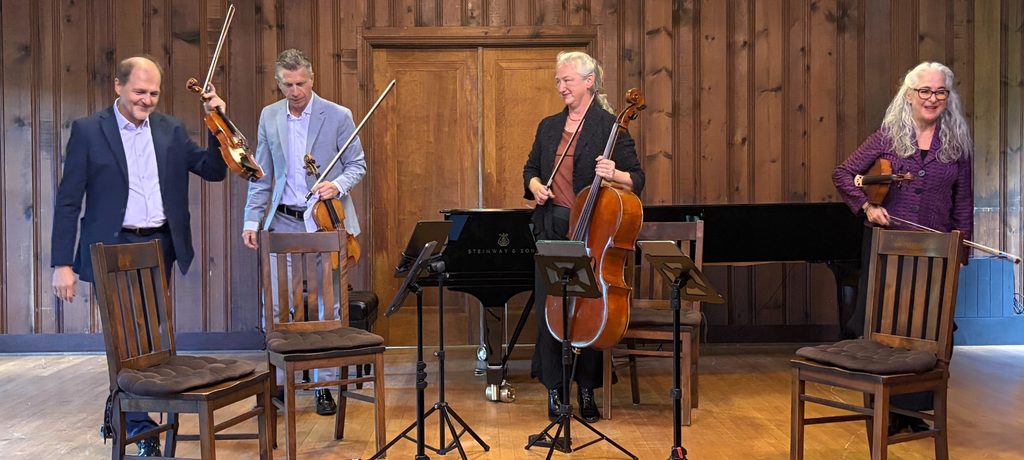
String Quartet #4 (2016) by Krzysztof Penderecki was a late quartet written forty years after his second quartet. The Adagio appears to be a slow lament about the Jewish Holocaust. The Vivo delivers a lively set of memories about his father, a string musician who played with his friends. These are the cherished memories of a child, as a man recalling the tunes played. Some of the melodies reference Jewish tunes. This short work is both charming and tragic.
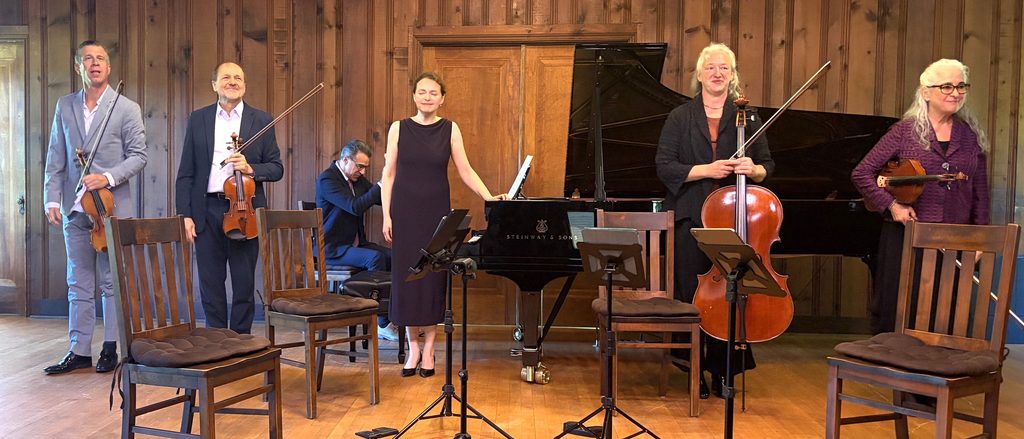
Victoria Schwartzman joined the Penderecki Quartet. She played with thrilling eloquence, lending support and at times leading the quintet with assured, soothing panache. In the second movement, Ukrainian Dumka Andante, she played with anguished lament; the slow dumka memorialized the Russian pogrom in Ukraine during the year of 1882 in Kiev, Odessa, as well as the countryside.
The quintet was appropriately fierce in the lively Scherzo Furiant and in the exciting Finale. All five members of the Penderecki Quintet played with such tight unity and zest that the rousing, optimistic conclusion for a better future was a cathartic experience for all attendees! The audience erupted with a standing ovation and demanded two appreciative bows.
Next Sunday, the Music Mountain Summer Series concludes with Juilliard String Quartet:
Ludwig van BEETHOVEN String Quartet in F Major, Opus 135
Béla BARTÓK String Quartet #4
Antonín DVOŘÁK String Quintet in E Flat Major, Opus 97, “American”
Underwritten by Mike Abram and Vivian Garfein Abram