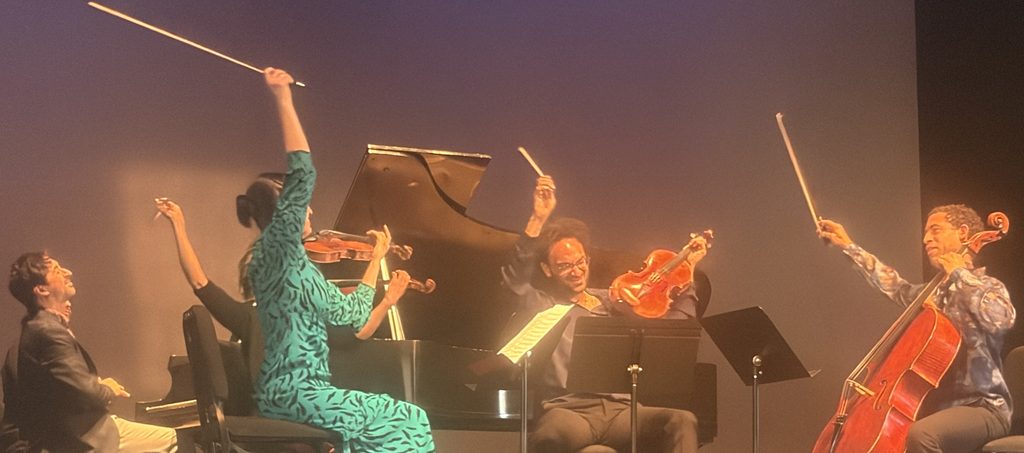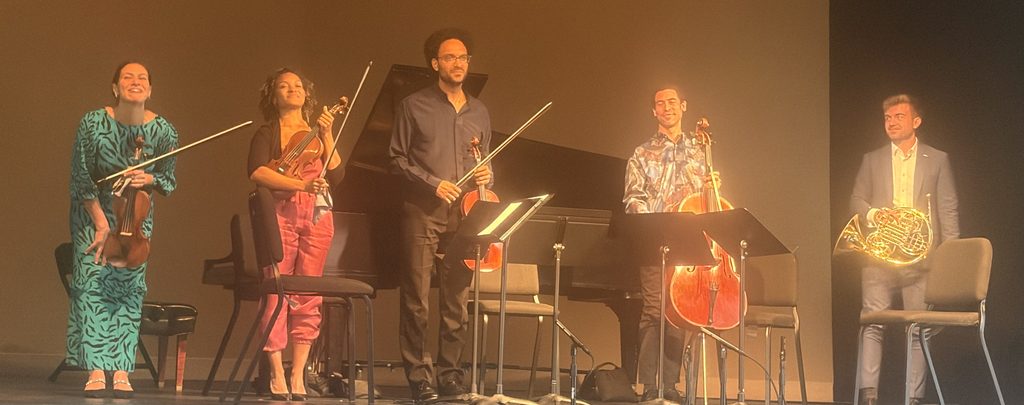
This past Sunday at the Hudson Opera House, in the Clarion Concert Series, the Kaleidoscope Chamber Collective from England performed a program focused on Robert Schumann (1810-1856) and two English twentieth-century female composers.
They opened with Schumann’s Adagio and Allegro for Horn and Piano, Op. 70, composed in February of 1849. Robert was excited about the development of new valves for the horn, yet he noted that if such new horns were not available a cello, violin, viola, or oboe would suffice as a substitute. At this point in his life, he was vigorously composing music each day. The work, in two movements, is in A major and A minor. The first movement offers nostalgia, while the second provides fantastic fury. Ben played horn with extraordinary finesse. On piano, Tom Poster supplied sumptuous elegance for this unusual parlor room composition. This novel and rather eccentric work demands an especially talented horn player. This was the third time I have heard this composition played, and this performance landed at the top.
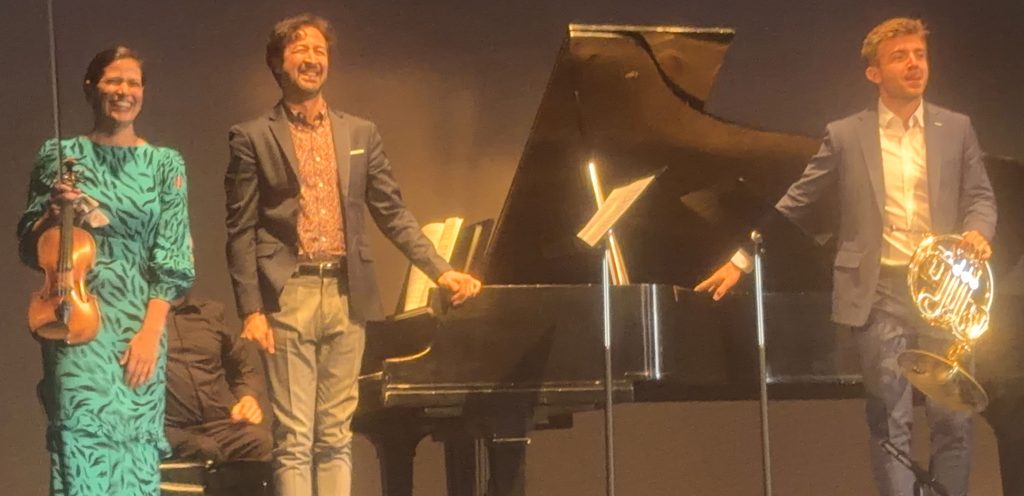
Trio for Violin, Horn and Piano (1928) by Ethel Smyth (1858-1944), a noted suffragette activist who composed her first hymn on piano at the age of ten, and later wrote the suffragette anthem The March of Women. Her opera The Wreckers (1893) was her best-known opera, yet it was not until 2007 that Leon Botstein produced it in America with the American Symphony Orchestra.
Elena Urioste on lead violin performed with expressive eloquence while Tom Poster offered rhythmic drive, and Ben Goldscheider supplied firm nuance in this late romantic composition that highlighted unusual structural contrasts between the instruments.
After intermission, they performed Shining Gate of Morpheus for Horn and String Quartet (2012) by Eleanor Alberga (b.1949), a contemporary Jamaican composer who lives in England. At the age of five, she was already an impressive piano prodigy. This quartet has been recorded by Navona Records and is also available through many streaming services.
This fifteen-minute composition was inspired by Homer’s Odyssey in the passage where Penelope describes two kinds of dreams: the ivory gate of false dreams and the shining horn gate of true dreams. The quartet espouses the seductive qualities of false dreams while the horn denounces false dreams with dissonant disdain. Ben Goldscheider as gatekeeper offered adamant and ironic rejection of wealth, decadence, and power. On piano, Tom Poster offered the wonders of global travel, while Elena Urioste offered sexual seduction, and Juan-Miguel Hernandez on viola proffered riches, Tony Rymer on cello promised enduring fame, as Melissa White promised bodily health and longevity. Ben’s horn echoed with caution and resilience. This was a remarkable venture into dreamlike reality with sumptuous texture.
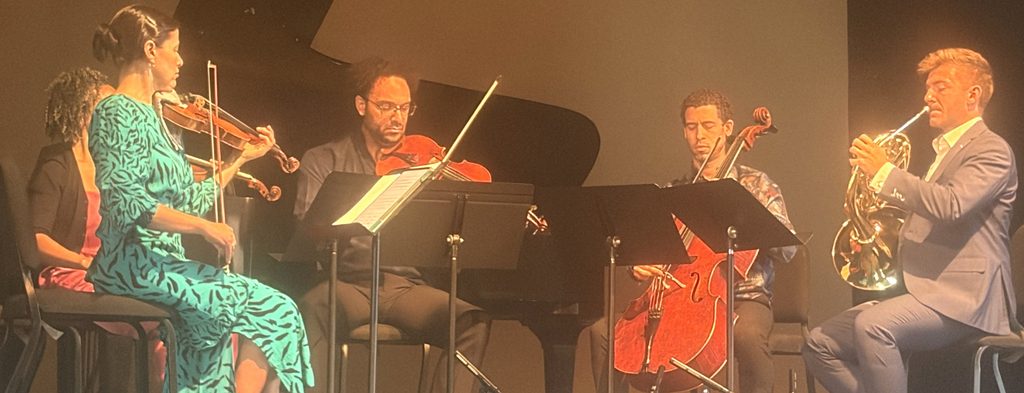
Piano Quartet in E-flat Major, Op. 44 (1842)concluded the concert. At this point in time, piano quartets were usually accompanied with double bass. The opening “Allegro Brilliante” brims with the recollection of holiday summer sunshine celebrated by violin and horn. The second movement features frenetic panic over the extended illness of their daughter Marie with dissonant horn and concludes with ghostly string chords, especially Urioste’s violin. The lively Scherzo celebrates the recovery of Marie’s health, and the genial concluding Allegro looks forward to happier family days, where Hernandez on viola stood out with enhanced warmth. Schumann regarded the quartet as a conversation among instruments; here was a conversation of deep family intimacy.
The next two Clarion Concerts will feature Clayton Stephenson with Kenari Quartet.