by Kevin T McEneaney
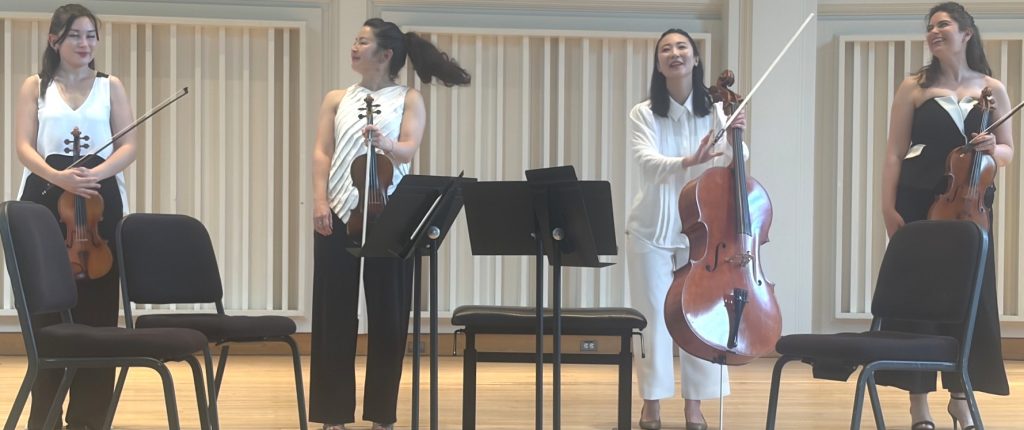
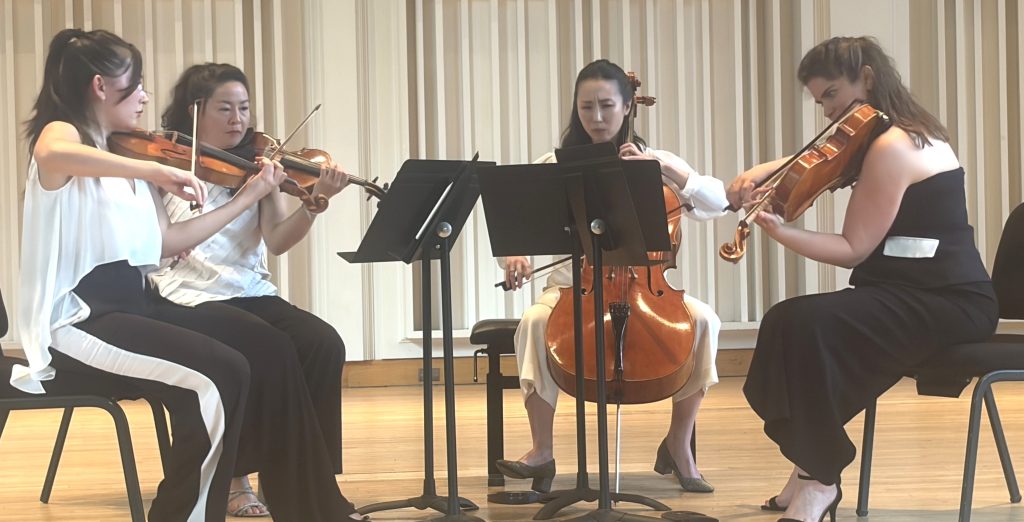
The Aeolus Quartet opened with String Quartet in D Minor, K. 421 (1783) by Wolfgang Amadeus Mozart (1756-1791). This work is nicknamed “the second Haydn Quartet” (of six) written when Mozart studied under Haydn, who approved the composition. The opening Allegro is an exciting shocker as first violinist Issabelle Ai Durenberger on violin delivered high screeches at fevered pace that dramatized anticipation of the coming birth of Wolfgang and Constanze’s first child, Raimond Leopold Mozart (named after Mozart’s landlord and Mozart’s father).
Constanze once wrote to a friend that the second and third movements were written in the bedroom during the birth and that Wolfgang included her screams in the second movement (the work was completed two days later).
This composition is often played to display that Mozart was the student who would go beyond Haydn, however, there is some controversy about how it is performed ever since the German critic and biographer Wolfgang Hildesheimer claimed (about fifty years ago) that the pitch of D Minor (Mozart’s Requiem is in D Minor) in that period was slightly higher than usually played today, which was the approach adopted in this performance. This interpretation results in highlighting the first violin while diminishing the gravitas and warmth of the cello, leading to a more comic inflection rather than highlighting the drama of possible calamity in the second movement, while also diminishing the repeating refrain of whirling figuration in the final movement, which became slightly bland rather than bursting with triumphant exhilaration.
There was no lack of excitement in the performance of Wild Summer by Joan Tower (2018, revised, 2026). Joan introduced the work as one of her delinquent children, yet the revised work has been transformed into a memorable masterpiece, performed here with high energy and fierce balance. On cello, Jia Kim was the Atlas who upheld the dizzy spin of this dense postmodern rucksack of intense explosions, while Caitlin Lynch on viola provided intimate warmth. Joan had revised the composition, working with the quartet, and the result was polished perfection. This work is only ten minutes long, and I wanted to hear it again as soon as it was over. The audience erupted with a long-standing ovation. I hope that the Aeolus Quartet will soon be recording this jewel on CD!
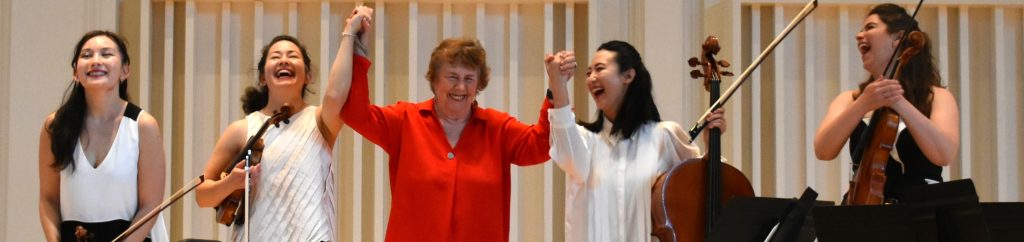
After the intermission, they performed String Quartet No. 3 (1947) by Grazyna Bacewicz. The chugging opening in the opening Allegro acknowledges the urgent importance of trains in reconstructing war-torn Poland, where the chief melody is assigned to the versatile viola of Catlin Lynch. The underlying sonata form appears to be overwhelmed by multiple directions and suggestions about priorities in reconstructing the country, with each instrument excitingly asserting important, divergent tasks as thematic recapitulation undergoes constant revision. The main theme of Andante begins as Romantically nostalgic with evocation of the past, yet that becomes transformed into robust modernism as the pathway to reconstruction. In the concluding Vivo, the second violin of Rachael Shapiro offered confident assurance that projects will be completed and that the country will move to prosperous independence. This Quartet acknowledges anxiety, which turns to confident assurance that the future will be bright, and the players incarnated that prospective view with confident, healing zest.
String Quartet No. 6 in F Minor, Op. 80 (1847) by Felix Mendelssohn was his last major work; he died two months later at 38 after a series of strokes on November 4, 1847. His beloved sister Fanny died of a stroke on May 14, 1847. His nickname was the “discontented Polish count,” due to his aloofness. In the opening Allegro, there is a tormented ambiance of hysterical grief where the slow, elegiac refrains offer temporary relief as strings put forth shuddering tremolos, where Jia Kim registered a frightening fear while the first violin of Isabelle Ai Durrenberger ascended to a fragile ray of light. The jagged syncopations of the second movement, Andante, eloquently captured confusion, while the concluding Allegro features brisk syncopation that evokes finality.
This was an unusual, surprising, and concluding choice for a concert, which set me thinking about the order of moods that the concert traversed. The concert opened with the excitement of birth, and we are currently celebrating the 250th year of our nation’s birth. The ten- minute composition by Joan Tower conjured thoughts about happier days in the 1970s or 1980s. The third work recalled our valiant effort to defeat fascism in Europe. The last work presented a requiem-like surrender to death. The program might appear to some as a political allegory of our collective past with a current focus on the present.
The next concert at Bard College, Olin Hall, in the Hudson Valley Chamber Music series will be on June 14, at 4 pm, featuring Espressivo! with pianist Ann Polonsky, Violinist Jamie Laredo, Sharon Robinson on cello, and Milena Pajaro-Van de Stadt on viola. The program: Ludwig van Beethoven, Piano Quartet in E-flat Major, Op.16 (1796); Book of Hours by Danielpour (2006); Piano Quartet in E-flat Major. Op. 47 (1842) by Robert Schumann.