by Kevin T McEneaney
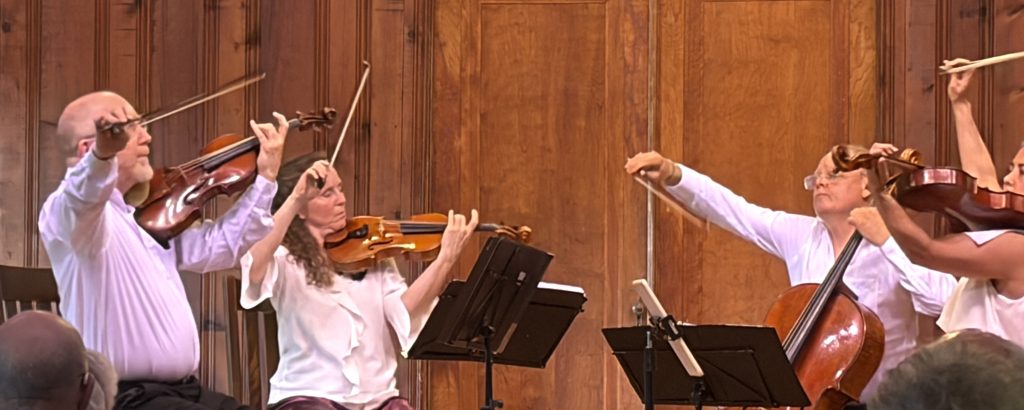
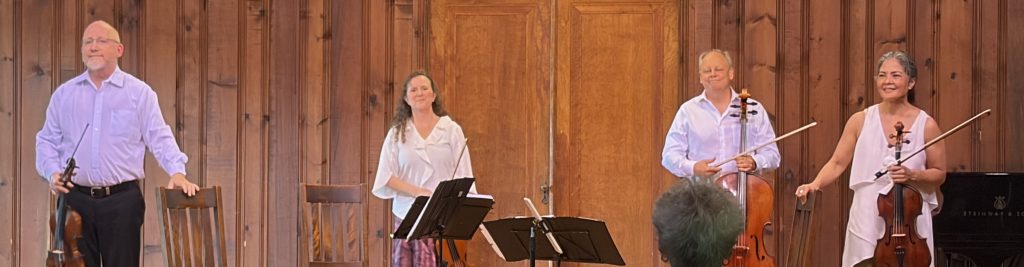
The Arianna String Quartet, currently one of the very top quartets in the country, was scheduled to play Last Sunday during the tornado storm, but the concert was cancelled. Since they were spending the week at Music Mountain, instructing with tutorials, they were able to perform their concert program on Thursday afternoon to a diminished but heartily enthusiastic audience who were transported to Cloud Nine.
String Quartet No. 6 in F Minor, Op. 80 (1847) by Felix Mendelssohn was his last major work; he died two months later, on November 4, 1847, at 38, after a series of strokes. (His beloved sister Fanny died of a stroke on May 14, 1847.) His humorous nickname was the “discontented Polish count,” due to his persistent aloofness. In the opening Allegro, there is a tormented ambiance of hysterical grief, where the slow, elegiac refrains offer temporary relief as strings put forth shuddering tremolos, while the fabulous first violinist John McGrosso registers a frightening, fearful lament, while the second violin of Corinne Stillwell ascends to a fragile ray of light. The jagged syncopations of the second movement, Andante, eloquently captured confusion with outstanding effect from Joanna Mendoza on viola and was assisted by cellist Kurt Baldwin. The following Allegro featured brisk syncopation that evokes the despair of finality, while the fierce concluding Finale retains a transcendent sense of loss….
They next performed Kanto Kechua #4, “For Béla” (2025) by Gabriela Lena Frank (b. 1972), one of this country’s leading composers. The reference to Béla Bartók signals his influence upon Frank’s methodology of working with indigenous folk music while also employing post-modern techniques as Bartók did with Hungarian and Romanian melodies. As a student, she played on piano all of Bartók’s compositions. Frank is the current recipient of the 2026 Pulitzer Prize in Music. This miniature masterpiece was written for the Arianna Quartet last year. As a child, Frank played both piano and violin. While she composes operas and symphonies, she has a special fondness for string quartets. Her mother was born in Peru and met her father there and they married in California.
There is a playful, introspective ambiance to this composition that bends pitch in amusing directions. Frank wove Andean folk music, especially native accordion motifs, into this postmodern gem that leaps from stumping sounds to the ethereal sublime as it imparts joyful ambiance. Sounds of the Quechuan language permeate the composition, transmitting a sense of timeless wonder. The enraptured audience demanded two bows.
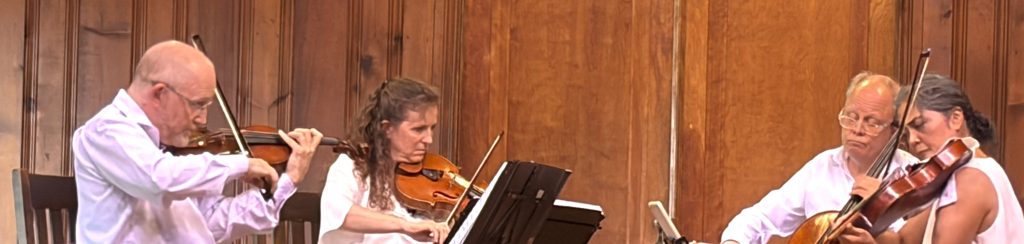
After the intermission, the quartet performed String Quartet in D Major, Op. 11 (1871)by Pyotr Ilyich Tchaikovsky. This was Tchaikovsky’s first quartet and his most popular composition during his lifetime. Since it overshadowed his astonishing catalogue, he developed an aversion to the work, which was somewhat reduced when he sat next to Leo Tolstoy at a public honouring of Tolstoy, when, during the second movement, Tolstoy was so moved that he cried tears.
The opening serenade movement, written in winter, has a sonorous simplicity that is quite attractive with lively syncopated rhythms in 9/8 time, where McGrosson on violin was plangently eloquent. The second movement, Andante, that evoked tears from Tolstoy, was based on a tune that Pyotr heard during the summer when he visited his sister’s house in Ukraine. Her Ukrainian gardener often whistled this Ukrainian folk tune as he worked. (The Russian government still, to this day, asserts that there is no such thing as Ukrainian folk music in the past or present, that Ukrainians only have gypsy music.) The cello of Kurt Baldwin was resonantly eloquent. (Tchaikovsky later arranged this movement for cello and string orchestra.)
In the third Andante Scherzo movement, the viola of Mendoza sang gracefully and memorably in 3/8 time. In the Allegro Finale guisto the second violin of Stillwell rose formidably to challenge and debate McGrooso’s first violin which soared with astonishing authority to conclude the debate.
I have a recording of this quartet by the Borodin Quartet, which I treasure, yet hearing the Arianna Quartet live displaced that recording.
Once again, the audience applauded loudly and long to receive a second bow….