by Kevin T McEneaney
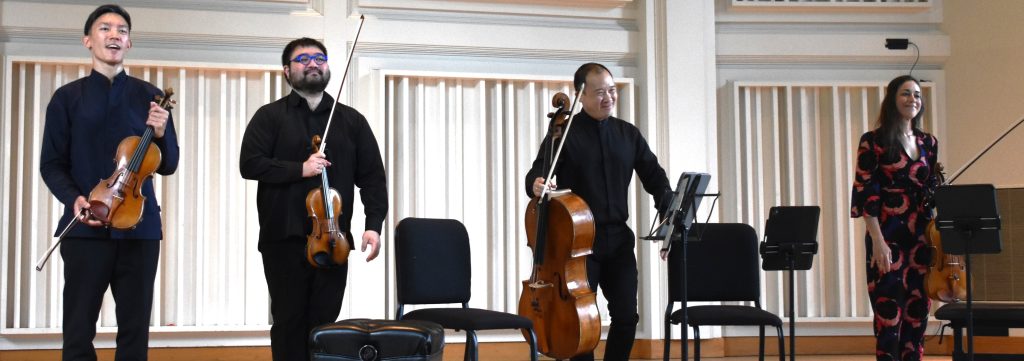
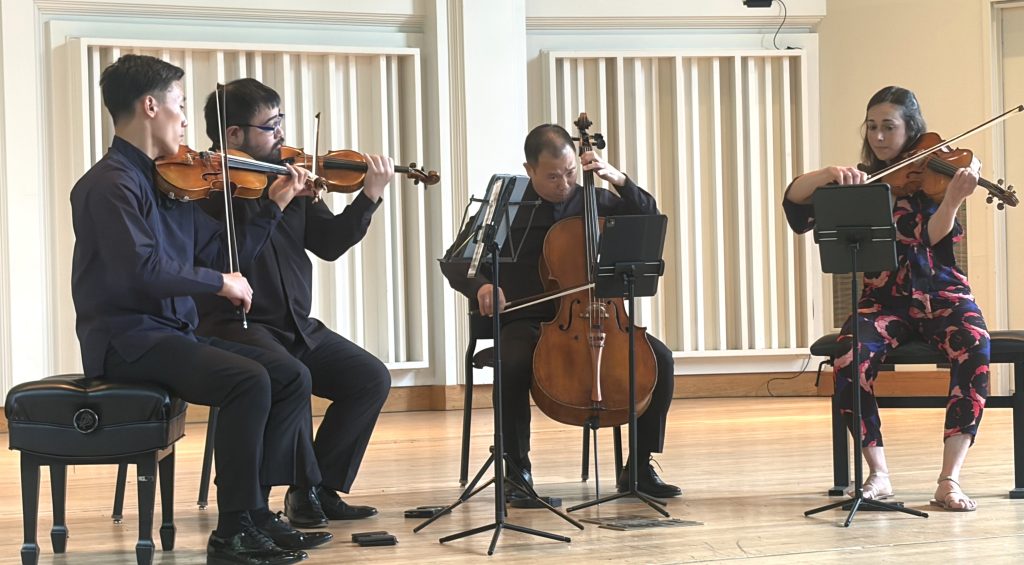
Last Sunday, The Parker Quartet, currently in residence at Harvard University, performed an exciting program at Bard College, Olin Hall. They opened with String Quartet No. 11 in F Minor, Op 95, called “Quartetto serioso,” written in the summer of 1810. Beethoven rarely gave linguistic labels to his compositions. While Beethoven was not yet completely deaf, he knew that he would shortly be so, and that was a terribly serious situation for a composer.
He withheld publication of this quartet, perhaps because of its elliptical tightness and impassioned thrust, written in “learned” style for six years, due to the experimental nature of the work, or perhaps because he feared that he would no longer be able to compose another quartet, but would have one in his “pocket,” in case he received a commission for a quartet. His next quartet composition was a dozen years in the future.
First violinist Daniel Chong embodied the fierce, passionate thrust of the densely wrought composition in the shocking dotted rhythms and unexpected pauses, which simultaneously register fear and a joyous love of music. Transitions embody confrontation, dispensing with expected key relations. There is a jolting jump from F minor to D minor. The opening furioso still haunts the work as high notes acclaimed fragile beauty with breathless passion.
These effects were fiercely seconded by Jessica Bodner on viola, while the cello Kee-Hyun Kim grounded the emphatic, lower register, while Ken Hamao on second violin registered mediating stability. There is a frightening, descending chromatic fugue where the cello asserts final gravity. At the time of composition, Beethoven experienced his second marriage rejection. While there is dramatic despair, there is still a whisper of hope in the spirited viola of Jessica Bodner.
In an 1816 letter, Beethoven wrote: “The Quartet is written for a small circle of connoisseurs and is never to be performed in public.” Anguish can be transformed into high art. The lucky audience applauded with vigorous clapping!

They next performed Strange Beloved Land (2013) by Paul Wianko (b.1983), who is the Chamber Music Director of the Spoleto Festival; he is the cellist for the Kronos Quartet. This composition was commissioned by Great Lakes Chamber Music and was premiered by the Parker Quartet on June 13, 2013. This was the first of his numerous compositions. This work is almost seventeen minutes in length with some arresting pauses.
The slow, somber, mysterious opening creates much suspense. The work is a requiem for his father; it engages the listener in a cathartic experience with slow, meditative rhythms and lyric plucking, which evoke memories of his father. It features dotted rhythms freighted with redolence and humor, where the cello of Kee-Hyun Kim was the lead instrument.
One feels suspense and transport into an Otherworldly realm through minimalistic progressions that are haunting. It was a wonderful postmodern companion to Beethoven. A reporter once called Paul “the Hagrid of the cello.” The composition is an unusual Orphic masterpiece! The audience stood and applauded, demanding a second bow. You can listen to this work for free at SoundCloud.
After the intermission, they performed String Quartet No. 6 in F Minor, Op. 67 (1875) by Johannes Brahms. This offered bucolic summer contrast inspired by Brahms’ favorite folk tunes with expert fiddling by violinists Daniel Chong and Ken Hamao, who floated shifting accents with aesthetic echo in the opening scherzo-like Vivace that sounds like an appreciative nod to Antonín Dvořák’s Bohemian rhythms.
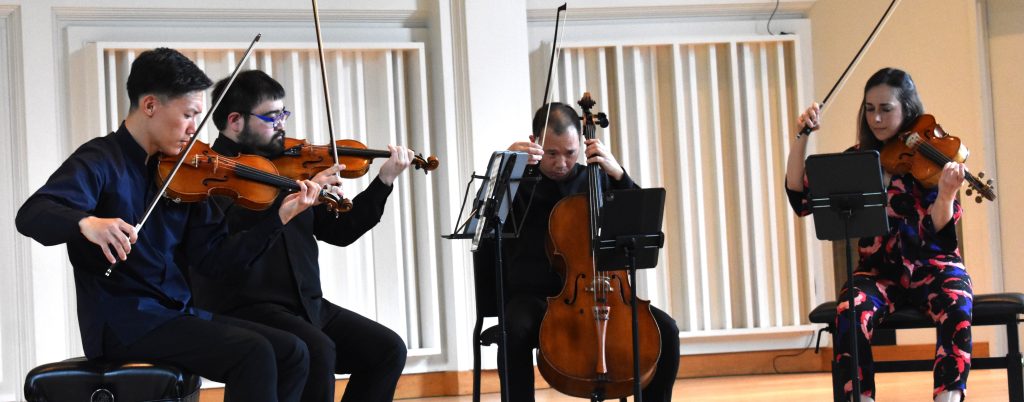
In the following Andante, there are some delightful echoes of Robert Schumann’s second symphony. In a letter to Clara, Brahms wrote that “only a German can compose, for only his deeply serious eye can still look forth full of love amidst great suffering.” The sufferings were the last years of Robert’s life and Brahms’ unrequited love for Clara, his faithful muse, who remained merely his closest friend. Here, violist Jessica Bodner adeptly captured the clarion voice of Clara.
The third movement, Agitato, appears to describe the final, gruesome asylum days of Robert Schumann, along with the current stifled passion of the composer. The Finale is a treasure trove of surprises, with a roving tonality related to the opening of Vivace. Brahms once described this movement as the most amorous, affectionate thing I have ever written. The final Coda suggests that he still entertained hope of marrying Clara.
The audience applauded and demanded three bows for this extraordinary concert. The next concert in this series of Hudson Valley Music Circle https://hvcmc.org/ features the Aeolus Quartet performing Mozart, Joan Tower, Grazyna Bacewicz, and Felix Mendelssohn on June 7, 4 pm at Olin Hall, Bard College.