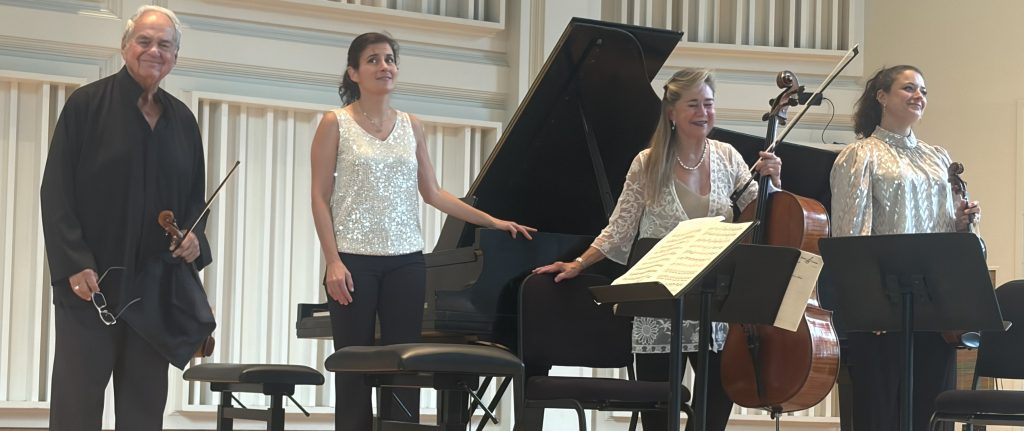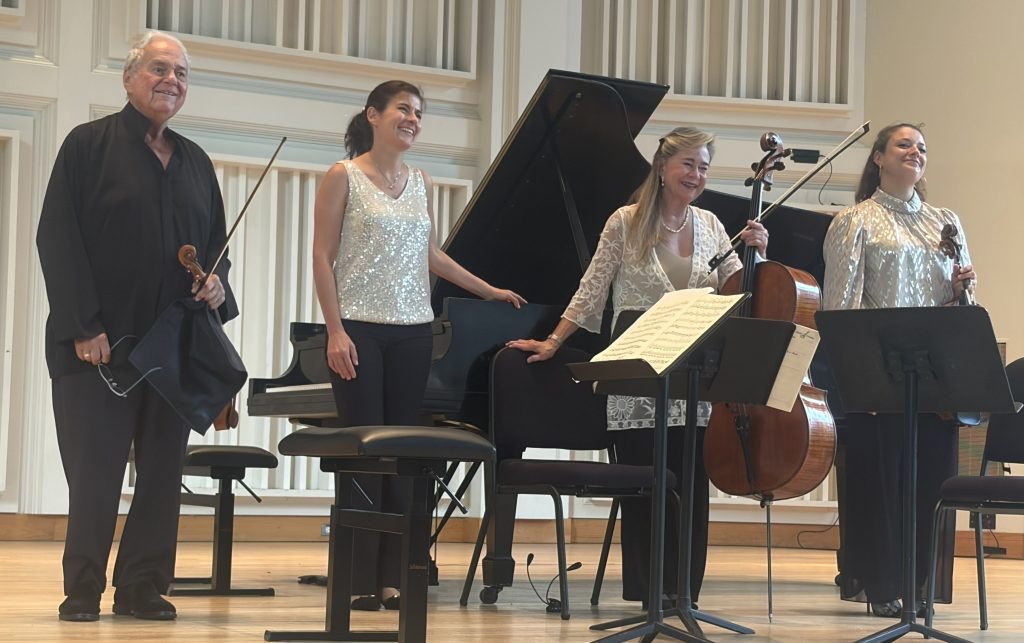
Last Sunday, the Hudson Valley Chamber Music Circle at Olin Hall offered an unusual concert program by Espressivo! The opener presented a once-in-a-lifetime experience of hearing an unpublished piano quartet by Beethoven. This was one of three piano quartets, written at the age of fourteen. The three-movement arrangement follows standard 18th-century formula for piano sonatas. In his youth, Beethoven’s father continually rebuked his son for playing anything that he had self-composed!
Piano Quartet in E-flat Major, Op.16 is based upon a Mozart Quintet in E-flat Major for piano, oboe, clarinet, bassoon, and horn, K. 452. That he was able both to model and go beyond Mozart at that age displays advanced genius. The serene, modest opening evolving into dotted rhythm in the Allegro, where Jaime Laredo’s violin sweetly sang, was quite attractive, yet the piano in the lithe hands of Anna Polonsky brought more characteristic excitement of the composer himself. In the second movement, the violin leads, yet the viola of Milena Pájaro-Van de Stadt was more assertive, as if in paying homage to Mozart’s second instrument. The third movement Rondo was underpinned by the cello of Sharon Robinson, while the piano took flight into empyrean skies with explosive trills and thrills from a composer who was at the dawn of his epic life.
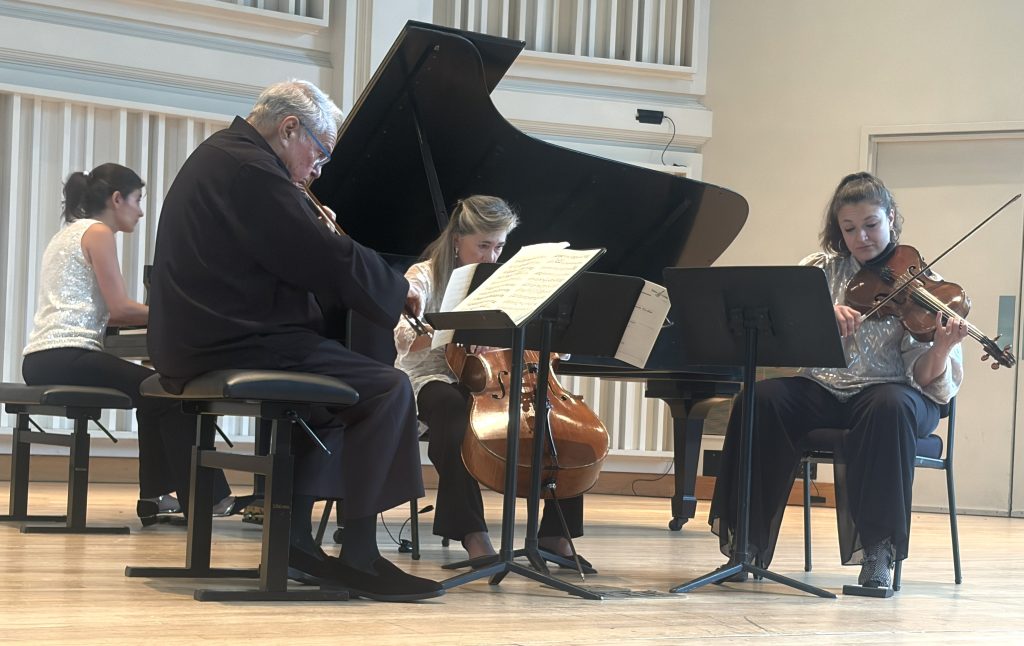
The Book of Hours (2006) by Richard Danielpour was an interesting, meditative work which may have been inspired by (Times of the Day, 1928) by Richard Strauss in four parts (morning, afternoon, evening, and night), a choral hymn to nature characterizing the psychological ambiance of a single day in a forest.
This modern updated motif (of morning, early afternoon, late afternoon, and evening) appears to begin indoors with a composer mysteriously involved in composing music, bright inspirations from the violin. There are revisions, twists and turns, of a composer at work. We are asked to inhabit the composer’s mind and co-experience the project of musical creation in the morning. Early afternoon sounded like small household chores, perhaps correspondence or phone conversations, with the viola able to do multiple tasks. Late afternoon was lively, robust with outdoor work, clatter, maybe small construction of some sort with cello avidly grunting. The mellow bliss of evening was blessed by the piano with satisfactory reverie and awareness of the brevity of our lives. This composition is an evocative meditation on life. My favorite movement was the first, and nearly equal was the transcendent mood of the finale!
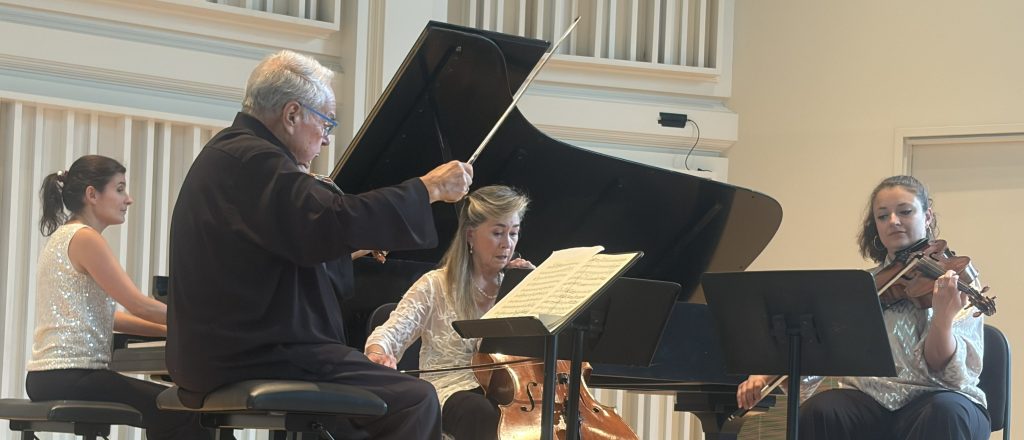
Piano Quartet in E-flat Major, Op. 47 by Robert Schumann (1842) is an exhilarating tribute to Clara Wieck, the only pianist that Chopin ever encountered who was able to play Chopin’s work intuitively and correctly, according to Chopin. Here, Polonsky became the living incarnation of Clara at the keyboard from the opening Allegro to the formidable finale. The repeating theme of ascending and descending scales challenges the strings to plunge into counterpoint. The opening themes are recalled and are transformed into an exciting double fugue that is so memorable. Liszt was so jealous that he criticized the work as too conventional and too popular. And yes, the audience loved this marvelous performance and demanded two bows for this most memorable concert….