by Kevin T McEneaney
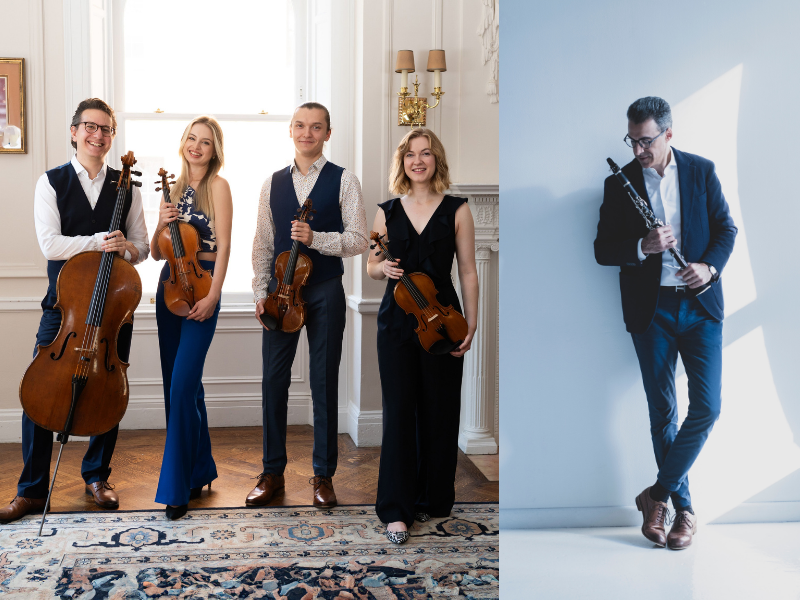
At the Wethersfield Estate in Amenia last weekend, the Erinys Quartet (named for the furies of Greek mythology) opened with String Quartet in D Minor, K. 421 (1783) by Wolfgang Amadeus Mozart (1756-1791). This work is nicknamed “the second Haydn Quartet” (of six) written when Mozart studied under Haydn, who approved the composition. Constanze’s first child, Raimond Leopold Mozart (named after Mozart’s landlord and Mozart’s father). Constanze once wrote to a friend that the second and third movements were written in the bedroom during the birth and that Wolfgang included her screams in the second movement (the composition was completed two days later).
This composition is often played to display that Mozart was the student who would go beyond Haydn; however, there is some controversy about how it is performed ever since the German critic and biographer Wolfgang Hildesheimer claimed (about fifty years ago) that the pitch of D Minor (Mozart’s Requiem is in D Minor) in that period was slightly higher than usually played today, which was the approach adopted in this performance. This interpretation results in highlighting the first violin while diminishing the gravitas and warmth of the cello, leading to a more comic inflection rather than highlighting the drama of possible calamity in the second movement, while also diminishing the repeating refrain of whirling figuration in the final movement, which became slightly bland rather than bursting with triumphant exhilaration.
This work is not often performed and is sometimes nicknamed the “Second Haydn Quartet,” written when Mozart briefly studied under Haydn who approved the composition. This composition relates to the birth of Wolfgang and Constanze’s first child. Mozart composed the opening Allegro in anticipation of the birth of his first child. There is muted excitement and suspense in the first movement, especially from Elizabeth Stewart on first violin, who was astonishingly fabulous.
I have twelve books on Mozart, but only Jan Swafford’s 2020 biography of Mozart speaks of the setting. Late in life, Constanze wrote a letter to a friend saying that the second movement was written in the bedroom during the days before birthing, while Constanze lay helpless in bed attended by the midwife.
This second movement, Andante, slightly Haydnesque, was so warm and loving that I wanted to hear it again. This movement re-imagined birthing screams, yet was also remarkably tender, dramatizing the care Constanze was receiving from the midwife and Wolfgang. Here Thompson Wang on second violin was formidable, while Celia Morin on viola added tenderness, echoed by Stergios Theodoridis on cello. Despite the difficult birth, the Scherzo rejoiced at the successful delivery, although the labor was long and bloody. There is a puckish celebration with a slow, meditative descent, perhaps a forward-looking anticipation of Raimond’s first steps.
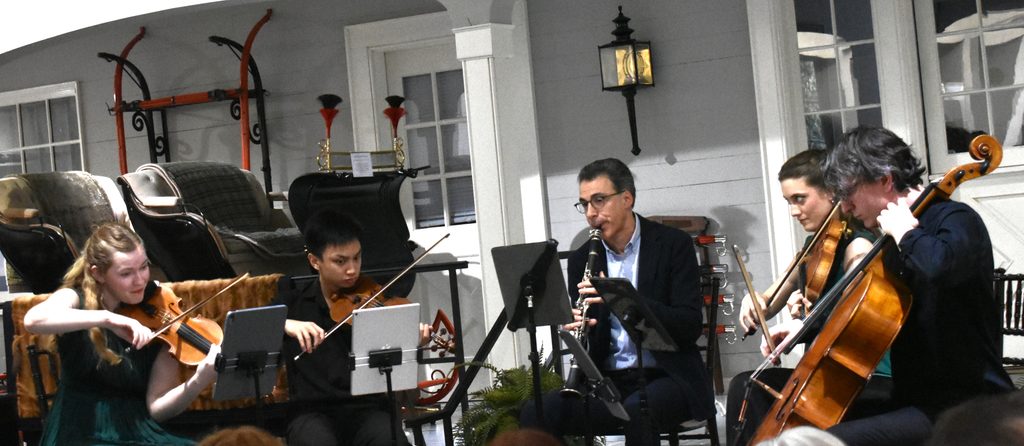
The concluding Allegretto was a Minuet, a delightful dance summation that declared all is well, where composing may have acted as a tonic that cured the composer of a long-standing cold. (Wolfgang had stopped drinking during the birthing and recovery of Constanze.) On first violin Elizabeth Stewart on violin carefully assisted that calm transition back to serenity at the conclusion with a joyous pace created through the addition of an extra note that repeated a triplet motif from the first movement. Some high notes dramatized the baby crying and the Minuet concluded with a rocking theme, which was slightly repetitive yet charming.
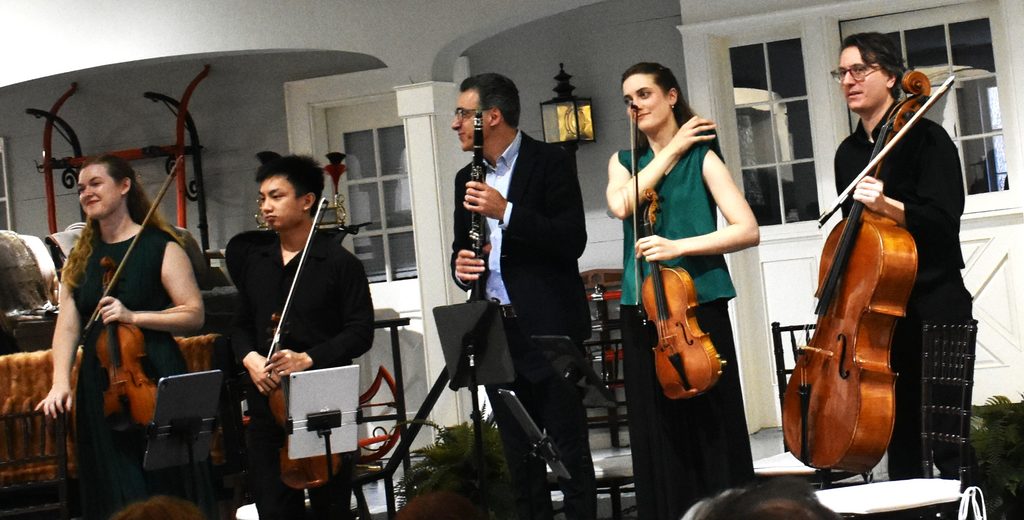
After a brief Intermission, they returned to perform Rêverie Orientale for Clarinet Quintet by Alexander Glazunov (1865-1936), who was an important Russian composer whose idiom often looked backward to the virtues of Romanticism. He abandoned Russia in 1928, went to France, then visited America, but settled in Paris until his death. This dreamlike chamber music piece opens with a stark and arresting clarinet solo by Oskar Espina Ruiz, the Music Director of the summer series at Music Mountain in Connecticut. Among musical instruments, the clarinet is the closest instrument to the human voice. This eloquent opening Prologue placed the hearer in the vast mountains of east Russia far removed from the bustle of cities as Oskar’s clarinet joyously evoked the rising sun. The Erinys Quartet then joined Oskar as a small town bristling with energy in this remote landscape where industrious inhabitants attended to their daily chores, celebrating their remote resilience in a difficult landscape. The second movement, melancholy Adagio, emphasized the town’s remoteness from the rest of the globe; Oskar’s warm clarinet asserted the dignity of humanity struggling to survive the weather and isolation, loneliness being a constant predicament. This was a deeply plangent cry from the heart with backing from the Quartet. The echoing conclusion still haunts my ears as I write.
Oskar remained with the Quartet to perform The Last Jew in Hamadam, for Clarinet Quintet (2006) by Richard Danielpour (b.1956). Like Glazanov, Danielpour combines elements of popular music in classical format. His ancestors came from Hamadan in Iran, which for centuries enjoyed a thriving Jewish community that has dwindled from several hundred to a mere fourteen inhabitants who remain under duress due to their religious identity. As in the Glazunov composition, Oskar’s clarinet portrayed the voice of a single person clinging to tradition amid social isolation.
Psychologically speaking, the theme of isolation in the music encouraged attendees to mingle and converse with each other, the result being much animated conversation and the discovery of interesting neighbors who now carry memories of a spectacular gathering!