by Kevin T McEneaney
In the winding woods north of New Milford, CT, The Sherman Ensemble opened with Flute Quartet in D Major, Op. 5, No. 3 (1776). In his introduction, Eliot Bailen noted that some scholars question whether Haydn wrote the piece. Some suggest it may have been composed by Haydn’s younger brother, Michael, or by another composer, arguing that it does not sound like Haydn. Michael was an important composer whose music deserves more frequent performance; his finest works were usually religious in subject matter.
This early work opened with a charming Presto theme, and my imagination pictured a cottage in the woods. The Menuetto was a walk in the woods; the following Adagio was a hunt with Susan Rotholz on flute calling the hounds and the Presto Assai described a successful, exciting conclusion that was brilliantly successful as Susan delivered a breathtaking conclusion. I concluded that this was early Haydn before his more mature and complicated style. Haydn’s love for depicting landscape shines throughout his opus. This was a showcase for Susan’s adroit, nimble flute, with Doori Na on violin, Eliot Bailen on cello, and David Creswell on viola, all performed with immaculate, rhythmic resonance.
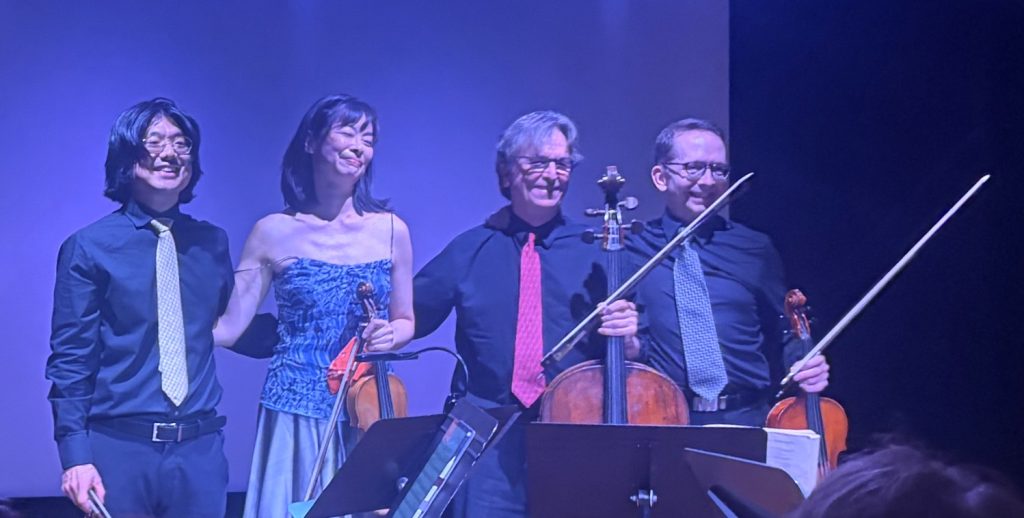
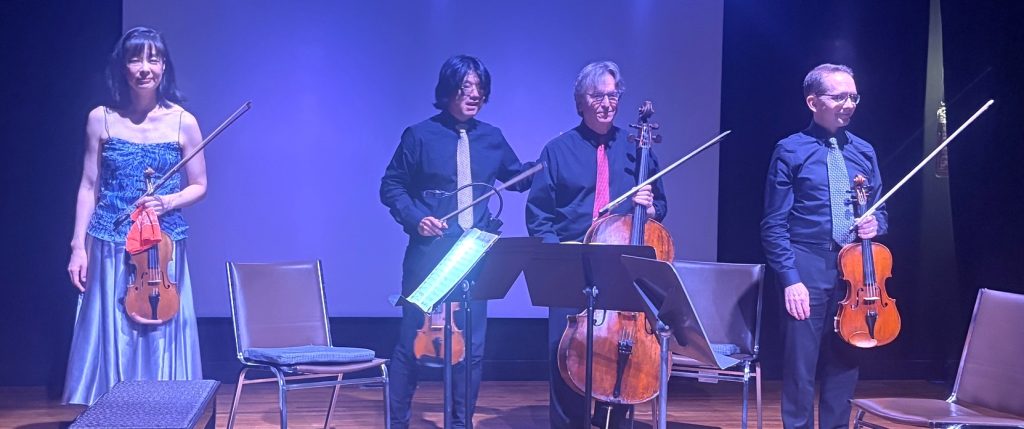
String Quartet in D Major, No. 21, K. 575 (1790)by Wolfgang Amadeus Mozart, the first of the so-called “Prussian” Quartets, opened with a conversational Allegretto theme where a query at a festive court dance was passed from Jane Chung on first violin to the second violin of Doori Na, then the viola of David Creswell; a second theme from Bailen’s cello replies, as if another man began speaking to the family. The delightfully tranquil Andante is an expansion of the melody from “The Violet,” a popular song composed by Mozart five years earlier. The Menuetto dramatizes the courting dance with the violet daughter at the court festival. The Rondo Finale resembles the theme of the Violet song as it depicts a successful, melding courting dance where the cello, which represents the German King. The Prussian King was an amateur cello player, and Mozart was flattering the King with his witty, imaginary joke of a young, beautiful woman willing to dance with the King. This cyclic recapitulation created a new, popular trend in nineteenth-century music that Wagner savagely denounced.
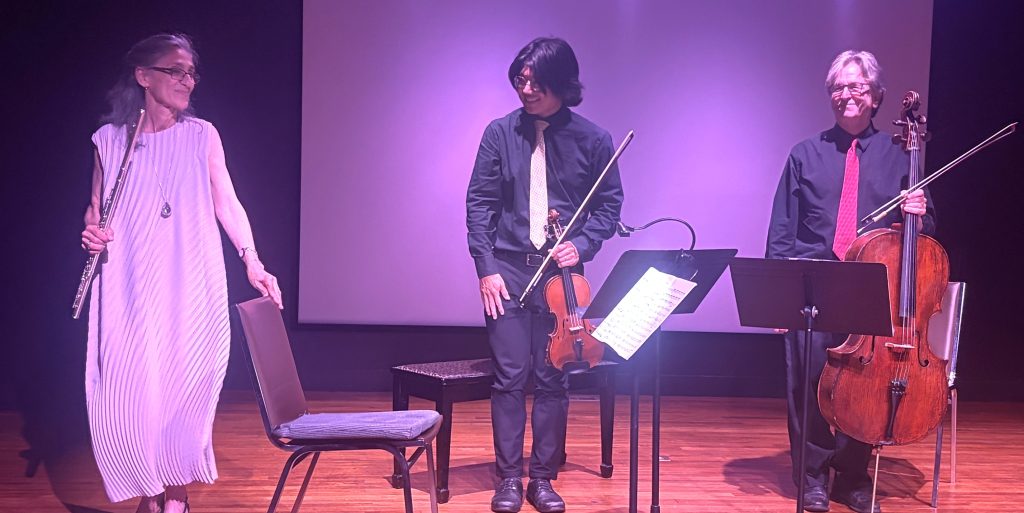
Rondo Allegro by John Antes (1740-1811, the first important American classical composer, was performed as an early example of American virtuosity. The date is uncertain. Antes had met Haydn in Europe but spent most of his life in Egypt as a Moravian missionary. Most of his compositions have been lost. Susan Rotholz lead the Trio in a movement of one of his compositions with marvelous panache as she was accompanied by Doori Na on violin and Eliot Bailen on cello. Since this is the country’s 25oth anniversary, one might think that The Kennedy Center would be performing the surviving compositions of Antes, yet they appear to be bogged down in planning a third concert for Kid Rock. This was a surprisingly charming composition!
Quartet in F Major, Op. 59, No. 2 by Ludwig van Beethoven provided the stormy conclusion of the concert with dramatic, bleak, elusive mystery. The work opens with a question with a silent pause, stopping again for another pause. The second movement, Adagio, has a slow, meditative pace that expanded to sonata format during which Doori Na on first violin, played with his eyes closed. He played about 80% of the concert with closed eyes and a winsome smile. Bailen’s haunting cello was an eloquent, meditative commentary that was the foundation of the composition. The jagged rhythm of the Scherzo brimmed from Creswell’s viola. Jane Chung, on second violin, delivered contrapuntal eloquence. The amazing Presto Finale, which occurs in C major, arrives like the sun rising over an impressive mountaintop with fluctuating tonality that lingers with ambiguity. In the final racing coda, E minor expels C major in fortissimo as despair shakes the room with dramatic authenticity and authority, which presents, in our current context, a political allegory of our present lives.
This was a concert that thrived on eloquent sobriety with aesthetic eloquence and concluded with a howl to the moon!