by Kevin T McEneaney
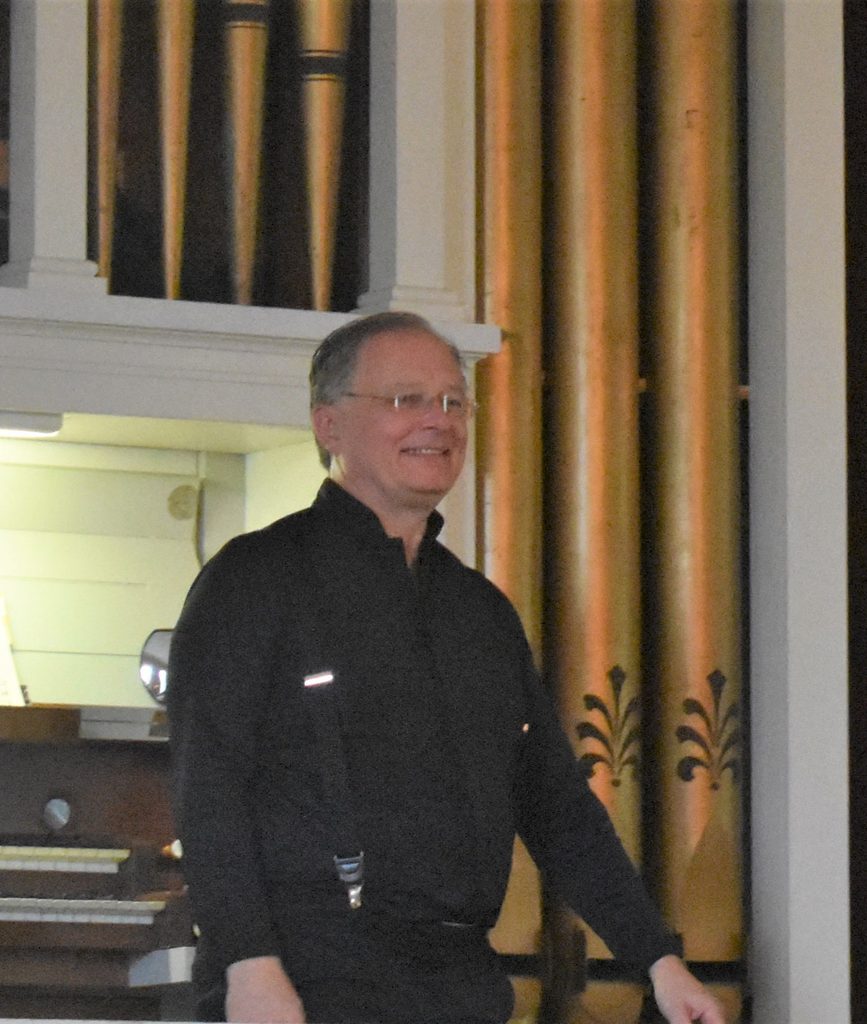
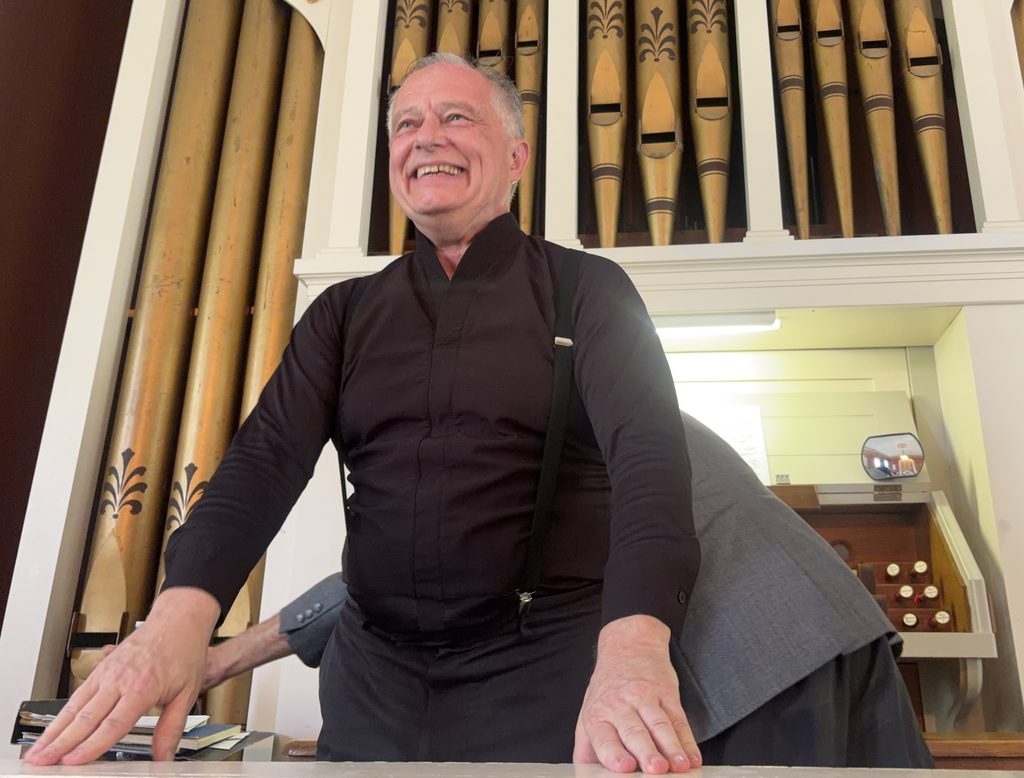
This was the fourteenth appearance of Kent Tritle in the intimate setting of the historic Smithfield Church. In addition to his renown on the tracker organ and his position as organist for the New York Philharmonic, Mr. Tritle is also hailed as one of America’s leading choral conductors. He performed on the church’s 1893 Johnson and Son tracker organ. Rev. Douglas Grandgeorge introduced Mr. Tritle.
At an organ concert one may see the fingers of an organist rapidly massaging the keyboard, yet that indicates only half of what is happening. Hidden from view, the player’s feet are racing, as if they were track stars. The best organists are ambidextrous with both hands and feet.
Mr. Tritle opened with Praeludium in E Major, BUX 141 by the Dane Dieterich Buxtehude (1637-1707), who became an organist in Lübeck in northern Germany. His specialty was the fantastic style of keyboard runs and pedal solos with fugal counterpoint. He was the man whom Bach modelled himself on. This work was an intricate express train to a land you never dreamed of. Girolamo Frescobaldi (1583-1643) was known as the keyboard genius of his era. Known for surprising harmonic shifts, dramatic pauses, and echo effects. Here, the five toccata dance themes painted the air with diverse dramatic rhythms, inviting the audience to choose a favorite rhythm. This selection displayed a contrast of styles between northern and southern European styles. Frescobaldi had played for the Pope, but the Medici paid more, and he relocated to Florence.
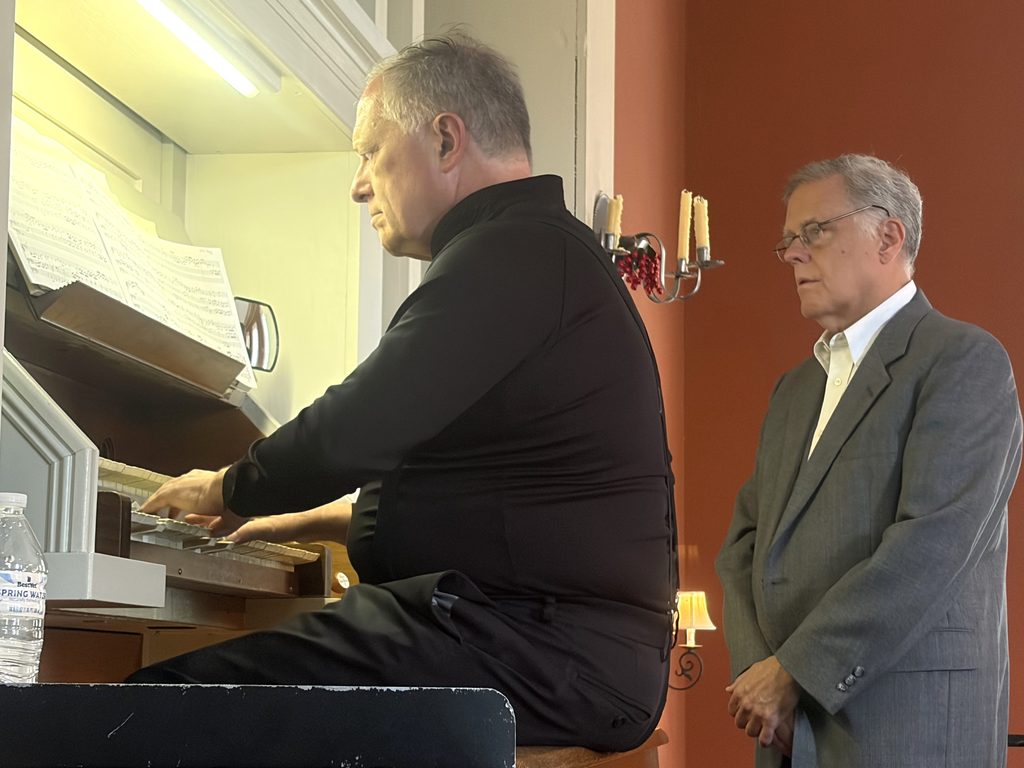
Wer nur den lieben Gott lässt walten, BWV 647 (Who only the living God lets rule) by John Sebastian Bach (1685-1750), who rose every morning at 4 am, drank three cups of coffee (we don’t know the size of the cups), while he smoked a fat cigar, which inspired him to work prodigiously every day. (I sometimes think that he would have lived longer, if he had dropped the cigar, yet maybe that would have diminished inspiration.) This work (produced in 1724) was a cantata performed on the fifth Sunday after Trinity Sunday. The cantata has seven movements as it invents triune themes redolent with devotional clarity. Here, Tritle soared and concluded with straightforward harmony that was impressive.
Prelude and Fugue in E minor, BWV 548 by J.S. Bach is nicknamed “The Wedge,” a contrapuntal pattern where two melodic lines move inward or outward by steps that clash against each other, usually in contrary or oblique directions. This was the amazing climax of the concert! Those somber bass lines of the fugue still ring in my ear….
Twelve Choral Preludes on Gregorian Chant Themes, Op. 8 Ubi Caritas (1947) by Jeanne Demessieux (1921-1968) supplied a devotional mood of religious serenity that cast a reverential spell within the church, so much so that it was the only performed work that did not receive individual applause because such applause would have seemed blasphemy, or misbegotten manners in the church benches.
Omaggio Festivo, Op. 89 by Rachel Laurin (1961-2023), a noted Canadian composer, blended traditional sonorities with edgy dissonance that featured a toccata and gigue, which transported me into a future world that was not science fiction, proving that great creativity can continue if we manage to maintain a future on this wondrous planet where a sense of humility may offer sane guidance.
Kent Tritle spoke about these compositions with a voice that could be heard by all, before performing each work. His lucid commentary provided background and historical context for each composition.
P.S. J.S. Bach’s famous study, The Art of the Fugue, was published in 1756; it sold only 30 copies and was forgotten for half a century.