by Kevin T McEneaney
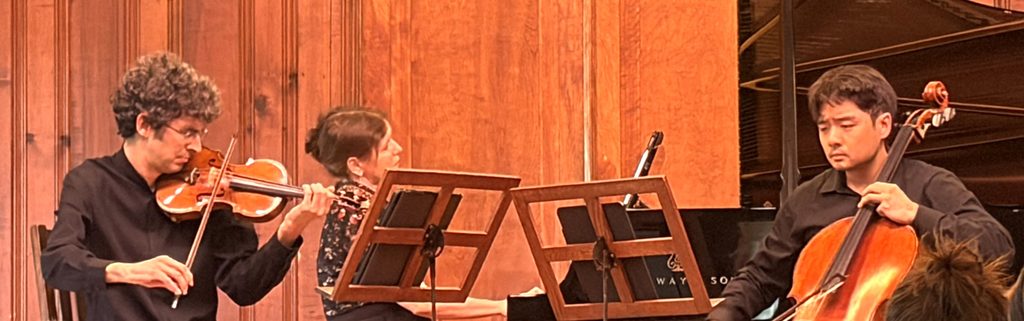
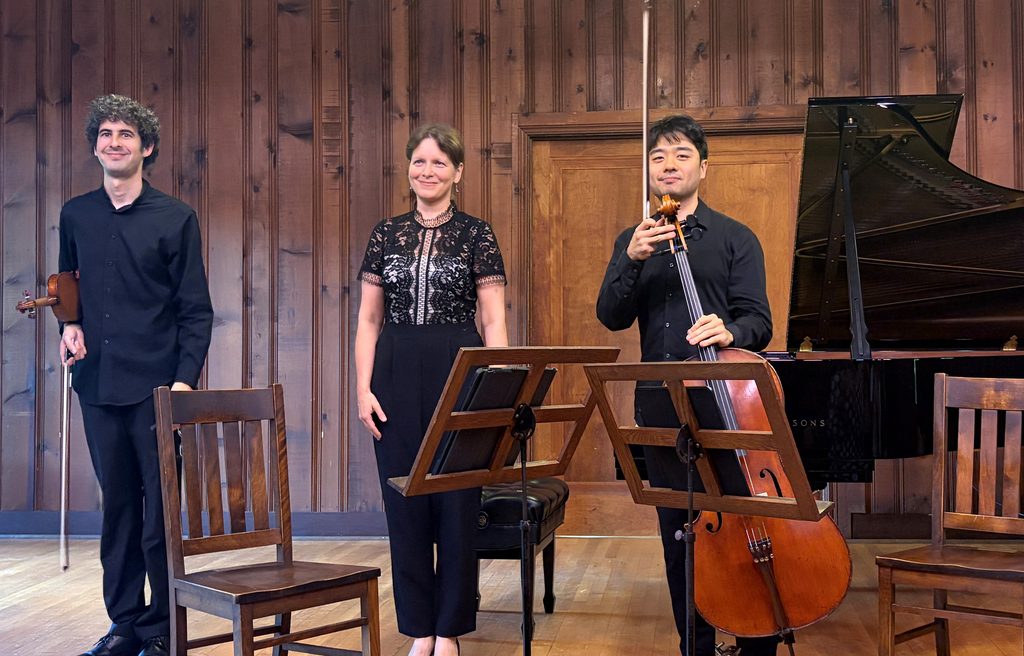
Last Sunday, under a bright blue sky and towering cumulous clouds slowly scudding above, The Lysander Trio performed an unusual musical program. They opened with Andante Con Moto (1878) by Edvard Grieg (1843-1907). Grieg completed his G minor String Quartet in the summer of 1878, then went to work on a piano trio that he never completed, or so it is often thought, yet the work appeared complete to me.
After his death, a close friend, pianist-composer Julius Röntgen, discovered the manuscript and fell in love with this sorrowful lament. Whose death it was lamenting, we do not know. Röntgen thought the work a masterpiece. The work was not published until 1978. Grieg never again attempted to compose a piano trio.
The monothematic movement is striking with hushed piano chords in unison octave. While the piano mourns, the violin (female) and cello (male) appear to swap anecdotes about the departed. The piano rises to a dramatic climax, then dwindles away….
Liza Stepanova on the keyboard performed with immaculate clarity while Itamar Zorman registered wailing grief and James Kim on cello delivered somber resignation.
Piano Trio in E Major, K.542 (1788) by Wolfgang Amadeus Mozart (1756-1791) was composed in Vienna over four months and completed in June. Mozart sent a copy of it to his sister Nannerl, requesting that she play it for Michael Haydn.
The simple but pliable melody, entrancingly dances under the fingers of Stepanova. The second movement, Rondo, was melancholy, and Itamar’s violin registered sorrow. The impressive Finale appears to celebrate the life of an important musical figure. I suggest this may be a tribute to Charles Wesley (the second largest composer of hymns after Fanny Crosby). Wesley died in March of that year. Michael Haydn, a composer of much religious music, was Joseph’s younger brother.
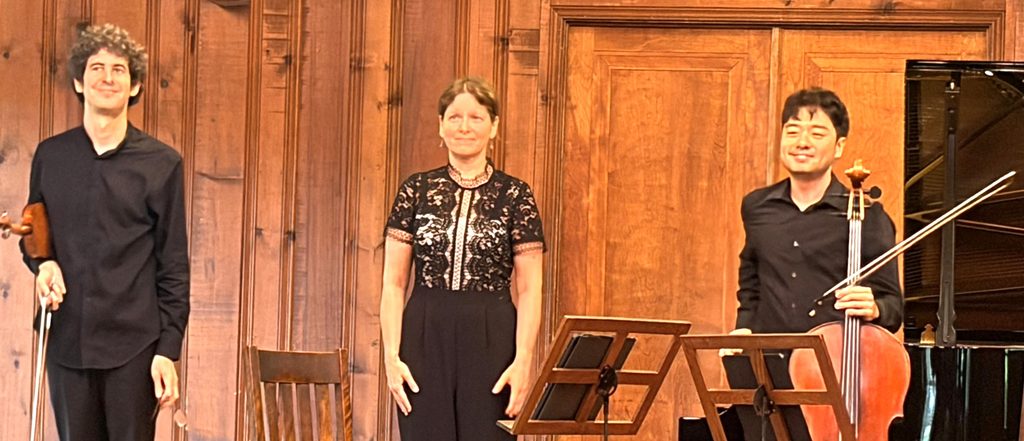
Color Through (2016) by Jennifer Higdon brought the concert to a sunnier reversal. This Pulitzer Prize winner remains the most performed contemporary American composer. As the daughter of an artist, it is not surprising that she has composed two piano trios on the theme of color. The first movement, “Wondrous White” echoed the cumulus clouds outside the venue, but everyday objects inside a house, like a teapot, sheets, platters, and vases. This piece was shockingly amusing as a contrast to the other works performed. The second movement, “Brilliant Blue,” is my favorite, yet I must confess that blue is my favorite color. Blue was displacing the white clouds above, and when the rhythms of gurgling streams and the vast oceans appeared, it was clear that blue had won that race! The Finale transmitted a buoyant optimism that was energizing. This was the first performance of Color Through at Music Mountain, and I hope it will not be the last….
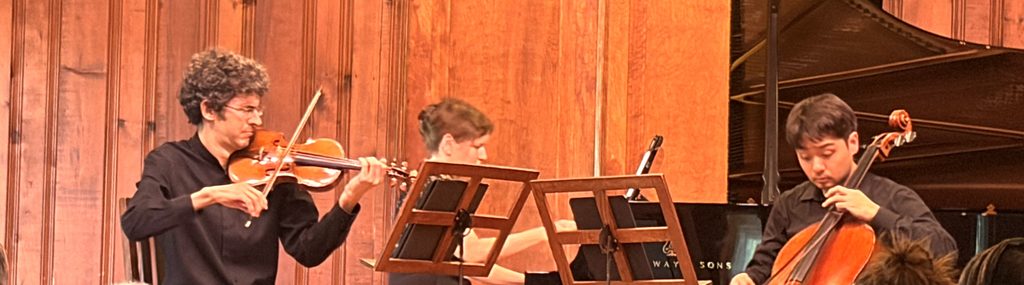
After Intermission, the trio performed Verkläte Nacht (Transfigured Night, Op. 4) by Arnold Schoenberg (1874-1951). This composition was based upon a German poem by Richard Dehmel. The poem has five stanzas and the composition has five movements of continuous play, telling the story of an unmarried woman who is pregnant, who then falls in love with a man whom she would prefer to marry. This is a haunting work, and I must say that James Kim on cello excelled here. This composition is a sextet, and each member of the trio played as if their shadow double accompanied them!
The audience demanded three bows, and the players consented to an encore. They performed the first of Samuel Coleridge-Taylor’s Five Negro Melodies for Piano Trio, Op. 59 (arranged from his 1906 collection of Twenty-Four Negro Melodies). I’m a fan of Coleridge-Taylor, who once performed at the White House for President Teddy Roosevelt.
Everyone departed with soothing serenity ringing in their ears on this sunny day to be remembered in tranquility….